
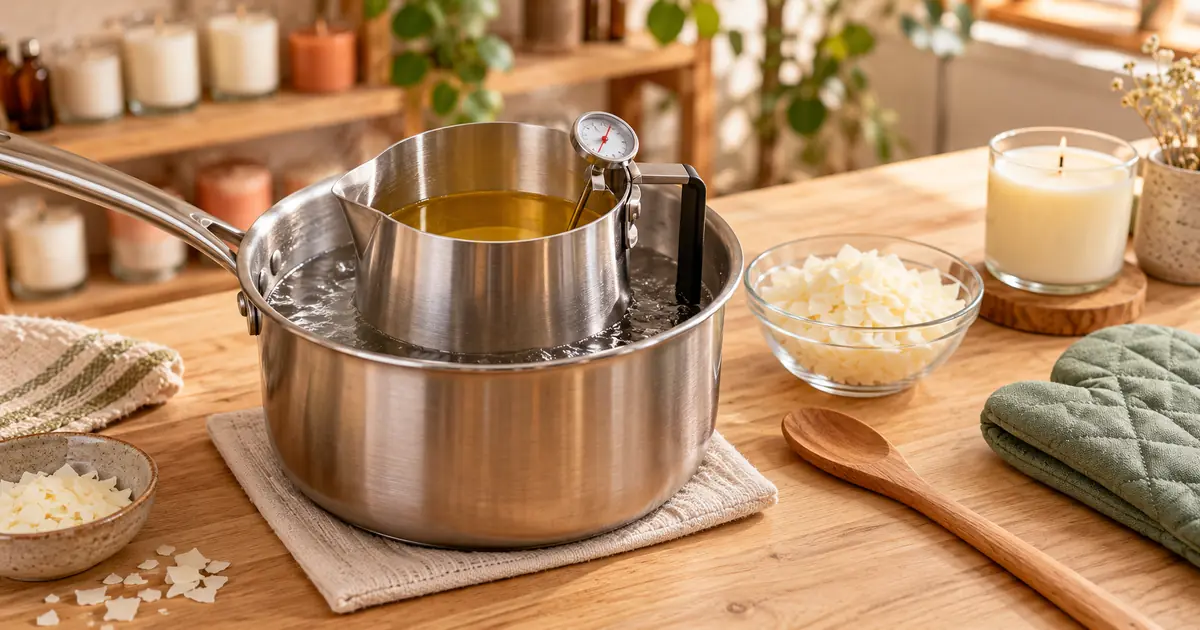
Melting wax is one of the most important—and potentially hazardous—parts of making candles. Wax needs controlled, indirect heat. Placing it directly over a burner can create hot spots, damage the wax and increase the risk of fire.
A double boiler for candle making solves this problem by using gently heated water to transfer heat into a separate pouring pitcher or melting container. This gives you more control over the wax temperature and makes it easier to produce consistent candles.
In this guide, you will learn how to set up a candle-making double boiler, melt wax safely, monitor its temperature and respond appropriately if the wax begins smoking or ignites.
Quick Answer
To make a double boiler for candle making, place a metal pouring pitcher containing wax inside a saucepan holding approximately 2–3 inches of water. Heat the water to a gentle simmer while stirring the wax and monitoring it with a thermometer. Never place wax directly over a burner or leave heating wax unattended.
What Is a Candle-Making Double Boiler?
A double boiler is a two-container heating system. The lower pot contains water, while the upper container holds the candle wax. As the water heats, it gently warms the upper container and melts the wax without exposing it to direct heat.
A typical candle-making setup includes:
- A stainless-steel saucepan for the water
- A metal candle pouring pitcher or melting pot
- A thermometer suitable for candle making
- A heat-resistant stirring utensil
- Oven mitts or heat-resistant gloves
- A stable stovetop or electric hot plate
If you are assembling your first workspace, our guide to the essential tools for candle making explains which supplies are necessary and which ones can wait.
Why Candle Wax Should Be Heated Indirectly
Candle wax may look harmless while solid, but it becomes extremely hot when melted. Heating wax directly in a saucepan can produce uneven temperatures and dangerously hot areas along the bottom of the pot.
Indirect heating offers several advantages:
- Better temperature control: The water bath slows the transfer of heat.
- More even melting: Wax melts gradually instead of scorching against the bottom of the pot.
- Lower fire risk: The wax is separated from the burner or heating element.
- More consistent results: Controlled temperatures make it easier to add fragrance and pour the wax at the appropriate time.
- Less discoloration: Excessive heat can darken certain waxes or change their appearance.
A double boiler does not eliminate every risk. You must still stay with the wax, monitor its temperature and keep the work area clear.

How to Set Up a Double Boiler for Candle Making
1. Add Water to the Lower Pot
Add approximately 2–3 inches of water to a sturdy saucepan. You need enough water to surround part of the pouring pitcher, but not so much that the pitcher floats or the water splashes into the wax.
Place the saucepan on a level burner or heating surface before adding the wax container.
2. Position the Pouring Pitcher
Place a clean, dry metal pouring pitcher inside the saucepan. The pitcher should sit securely without tipping or allowing water to enter it.
Use equipment dedicated to candle making. Even when a melting pot is manufactured from food-grade material, fragrance oil and candle dye residue can remain behind after cleaning.
3. Add the Correct Amount of Wax
Measure the wax before placing it in the pouring pitcher. Do not fill the pitcher to the top. Leave enough headspace to stir the wax without spilling it into the water or onto the heating surface.
If you are unsure how much wax your containers require, use our free candle wax calculator before beginning.
4. Heat the Water Slowly
Turn the burner to low or medium-low heat. Allow the water to reach a gentle simmer rather than a vigorous boil.
A rolling boil can cause the pouring pitcher to move, splash water into the wax or become difficult to handle. More heat does not necessarily produce better candles. Slow, controlled heating is the safer approach.
5. Stir and Monitor the Wax
Stir the wax gently as it melts. This distributes heat throughout the container and helps prevent small areas from becoming hotter than the rest of the batch.
Keep a thermometer in the wax or check the temperature frequently. Do not allow the thermometer to rest against the bottom of the pitcher, because the metal may be hotter than the wax and produce a misleading reading.
6. Follow the Wax Manufacturer’s Instructions
Different waxes have different melting, fragrance-addition and pouring temperatures. Even two products labeled as soy wax may have different recommended working temperatures because of their formulations and additives.
Always check the instructions supplied with your specific wax. Treat online temperature charts as general references—not replacements for the wax manufacturer’s directions.
How Hot Should Candle Wax Get?
The correct temperature depends on the wax, fragrance oil and type of candle you are making. The temperature required to fully melt a wax may be different from the temperature used to add fragrance or pour the candle.
| Stage | What to Do |
|---|---|
| Melting | Heat only until the wax is completely liquid, following the supplier’s recommended range. |
| Adding fragrance | Add fragrance at the temperature recommended for your wax and fragrance oil. |
| Cooling | Remove the pitcher from the water bath and allow the wax to cool gradually. |
| Pouring | Pour at the manufacturer’s suggested temperature for your wax and container type. |
A thermometer is essential. Appearance alone cannot tell you whether melted wax is within a safe or effective working range.
Suggested Double Boiler for Candle Making
You can assemble a double boiler from a saucepan and candle pouring pitcher, or purchase a coordinated set designed to fit together.

Can You Melt Candle Wax in a Microwave?
Some candle makers use a microwave to melt small quantities of wax, but it provides less temperature control than a double boiler. Microwave heating can also create hot spots that are not obvious from the surface of the wax.
If the manufacturer of your wax allows microwave heating, use a microwave-safe container, heat the wax in short intervals, stir between intervals and check the temperature frequently. Never assume a container is safe simply because it looks heat-resistant.
For beginners, a double boiler is generally the more controlled and predictable method.
What About an Electric Wax Melting Pot?
An electric wax melter can be useful when you regularly make larger batches or multiple candles at once. Many models include a thermostat or adjustable heat setting, reducing the need to maintain a saucepan of water.
However, an electric setting should not replace an independent thermometer. The temperature at the heating element may differ from the temperature in the center of the wax.
A basic double boiler is usually sufficient for beginners. An electric melter becomes more valuable when production volume increases and repeatedly melting wax in small pitchers becomes inefficient.
Common Double-Boiler Mistakes
Using Too Much Water
Too much water can cause the pitcher to float or become unstable. It also increases the chance of water splashing into the wax.
Allowing the Water to Boil Aggressively
You only need a gentle simmer. A hard boil does not significantly improve the process and makes the setup more difficult to control.
Getting Water in the Wax
Water can cause sputtering and may interfere with the finished candle. Keep the pouring pitcher dry, avoid excessive boiling and wipe moisture from its exterior before pouring.
Heating Without a Thermometer
Clear, fully melted wax can still be hotter than expected. Always use a thermometer instead of relying on appearance.
Walking Away from Heating Wax
Never leave melting wax unattended. Temperature can increase quickly, particularly after most of the solid wax has liquefied.
Using Direct Heat
Do not place a pouring pitcher filled with wax directly on a burner unless the equipment and wax manufacturer specifically provide instructions for that method. A double boiler is designed to reduce the concentrated heat that can cause overheating.
Using Candle Equipment for Food
Reserve pitchers, thermometers, stirring tools and other wax-contact equipment for candle making. Fragrance oil, dye and wax residue can be difficult to remove completely.
Review our guide to common candle-making mistakes before starting your next batch.
What to Do If Candle Wax Begins Smoking
Visible smoke is a warning that the wax may be overheating.
- Turn off the burner immediately.
- Do not move the container if doing so could spill hot wax.
- Remove the pitcher from the heat only if it can be done safely.
- Keep your face and hands away from the top of the container.
- Allow the wax to cool in a protected area.
Do not add fragrance oil, dye or water to smoking wax. Determine why the wax overheated before continuing the project.
If the Wax Catches Fire
- Do not pour water onto burning wax.
- Do not pick up or carry the burning container.
- Turn off the heat only if you can do so without reaching through or over the flames.
- If the fire is small and contained, slide a properly fitting metal lid over the container to smother it.
- Keep the container covered until it has completely cooled.
- If the fire is spreading or cannot be controlled immediately, evacuate and call 911.
Your safety is more important than saving the wax, equipment or work area.
Double-Boiler Safety Checklist
Before turning on the heat, confirm that:
- Your saucepan and pouring pitcher are stable.
- The pitcher and all tools are completely dry.
- You have a working thermometer.
- You know the recommended temperatures for your wax.
- The work area is free from paper, towels and other combustible materials.
- Children and pets cannot enter the workspace.
- Long hair is secured and loose clothing is kept away from the burner.
- A metal lid that fits the container is within reach.
- You will remain beside the wax throughout the heating process.
Frequently Asked Questions
Do I need a double boiler to make candles?
You need a controlled way to heat wax indirectly. A commercial double boiler is convenient, but you can also create one using a saucepan and a metal candle pouring pitcher that fit together securely.
Can I use a regular pot as a double boiler?
Yes. A sturdy saucepan can serve as the lower water pot. Use a separate metal pitcher or melting container for the wax and reserve all wax-contact equipment for candle making.
How much water should be in a candle-making double boiler?
Approximately 2–3 inches is enough for many setups. The ideal amount depends on the dimensions of the saucepan and pitcher. The water should surround the lower portion of the pitcher without causing it to float or splash.
Should the water touch the wax pitcher?
Yes. The heated water transfers energy to the outside of the pitcher. However, the water should never enter the pitcher or mix with the candle wax.
Should double-boiler water be boiling?
Keep the water at a gentle simmer. A vigorous boil can move the pitcher, produce steam and splash water into the wax.
Can I melt candle wax without a thermometer?
It is not recommended. A thermometer allows you to follow the wax supplier’s melting, fragrance-addition and pouring instructions while reducing the chance of overheating.
Can I pour leftover wax down the drain?
No. Wax can cool and harden inside plumbing. Allow leftover wax to solidify, then reuse or dispose of it according to your local waste requirements.
Can I use the same double boiler for food afterward?
It is better to keep separate equipment for candle making. Wax, fragrance oil and dye can remain in seams, handles and surface scratches even after cleaning.
Final Thoughts
A double boiler is one of the simplest ways to gain better control over candle wax. It heats the wax gradually, helps reduce scorching and gives you time to monitor temperature changes throughout the process.
The most important rules are straightforward: use indirect heat, follow the instructions for your specific wax, keep water out of the pitcher, monitor the temperature and never leave heating wax unattended.
Once you are comfortable melting wax safely, continue with our complete how to make candles guide for help selecting containers, wicks, fragrance and pouring temperatures.
Leave a Reply