
Candle Wax Cleanup Guide
Lift the wax.
Do not spread it.
The safest method starts with cold, not heat. Harden the spill, lift the wax from the outside inward, vacuum every loose fragment and treat only the residue that remains.
See the removal stepsThe short answer
How do you get candle wax off carpet?
Harden first. Lift second. Treat residue last.
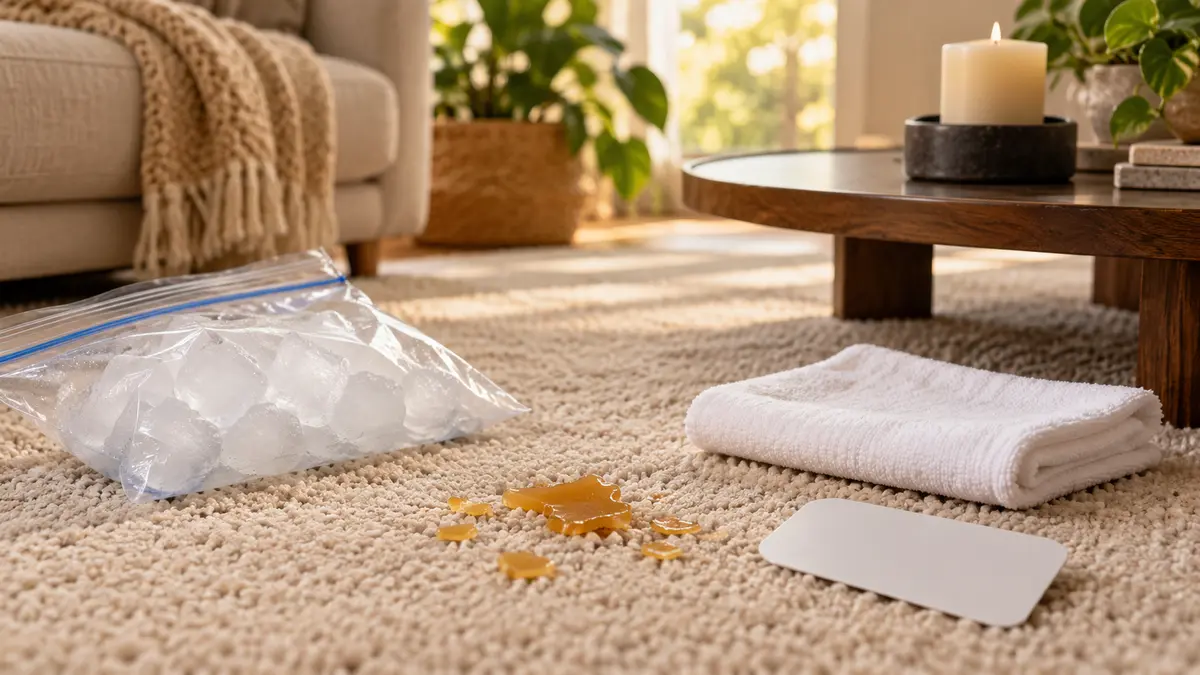
Do not wipe warm candle wax. Place ice in a sealed bag over the spill until the wax becomes hard, gently lift it with a plastic card or rounded spoon, and vacuum the fragments. Repeat before considering low heat or a carpet-approved spot treatment.
Stop before using heat if the carpet is wool, silk, sisal, jute, handmade, antique, valuable or made from an unidentified fiber. A professional cleaner is safer than experimenting on a surface that cannot be replaced easily.
Prepare before you touch the spill
Use simple tools that will not cut or spread the carpet.
Gather everything before beginning so the loosened wax does not have time to soften and settle back into the pile.
Why white cloths? They make it easier to see whether candle dye is transferring. Colored or printed towels can introduce dye of their own and hide the progress of the stain treatment.
The carpet controls the method
Identify the fiber before applying heat or cleaner.
Check the carpet or rug care label, purchase paperwork or manufacturer’s instructions. Nylon, polyester, olefin, acrylic, wool and plant fibers do not react identically to heat, detergent and solvent.
| Carpet or rug | Starting approach | Main concern | Best next step |
|---|---|---|---|
| Synthetic carpet | Freeze, scrape gently and vacuum. | Excessive heat can gloss, flatten, distort or melt fibers. | Use heat only if the manufacturer permits it and only at the lowest controlled setting. |
| Wool carpet | Remove loose hardened wax carefully. | Heat, aggressive rubbing and the wrong chemistry can damage the pile or dye. | Use a wool-approved cleaner or contact a professional. |
| Silk or handmade rug | Protect the area and avoid experimentation. | High risk of permanent texture, color and structural damage. | Contact a specialist rug cleaner. |
| Sisal or jute | Keep moisture to an absolute minimum. | Water can cause browning, shrinkage and ring marks. | Use a natural-fiber cleaning specialist. |
| Unknown fiber | Treat it as heat-sensitive. | You cannot predict the reaction to heat or solvent. | Stop after cold removal if residue remains. |
Always test any cleaner in a concealed area. If the test cloth picks up carpet color or the fiber changes appearance, do not continue with that product.
Cold-first removal method
How to get candle wax out of carpet without making the spot larger.
Let warm wax cool
Keep people and pets away from the spill. Do not wipe, press or scoop liquid wax. Touching it while soft pushes it across more fibers and deeper toward the backing.
Harden the wax with sealed ice
Place ice cubes in a leakproof bag and hold the bag over the wax for five to ten minutes. The goal is to make the wax hard and brittle without adding water to the carpet.
Work from the outside toward the center
Hold a plastic card, rounded spoon or blunt plastic scraper nearly parallel to the carpet. Gently lift the outer edge and direct every movement inward so the affected area does not expand.
Break away only what releases easily
Remove the largest pieces by hand. Do not pull aggressively on carpet loops or use a razor blade. If the wax bends rather than breaks, apply the ice again.
Vacuum while the wax is still brittle
Use a hose or upholstery attachment to collect the fragments. Avoid running the main vacuum head across the spill because its brush roll can grind particles into the pile.
Repeat before escalating
Freeze, lift and vacuum again. Several gentle cycles are safer than one forceful attempt and may remove enough wax that heat is unnecessary.
Inspect the residue
Use side lighting to distinguish shiny, stiff wax from a flat dye stain. If the fibers no longer feel coated, stop trying to melt wax and move to appropriate stain treatment.
Blot, rinse lightly and dry
If an approved cleaner is needed, apply it to a white cloth rather than the carpet. Blot from the edge inward, rinse with minimal clean water if directed, press dry towels over the area and vacuum only after it is completely dry.
Heat is optional, not automatic
Use the lowest effective heat only after the solid wax is gone.
A small amount of residual wax can sometimes be transferred into an absorbent cloth. Before trying either method, confirm that the carpet manufacturer allows controlled heat.
Lower-risk option: hair dryer
- Cover the residue with a clean white cotton cloth.
- Set the dryer to its lowest heat setting.
- Hold it at least six inches from the carpet.
- Warm the area for only a few seconds.
- Blot and move to a clean section of cloth.
Stop if the carpet becomes hot, glossy, distorted or produces an unusual odor.
Higher-risk option: clothes iron
- Turn the steam function off.
- Use the iron’s lowest temperature.
- Place several layers of white cotton cloth over the spot.
- Press for a few seconds without touching the carpet.
- Lift, inspect and reposition the cloth.
Never slide the iron across the carpet or leave it resting in one place.
Protect the carpet
Do not turn a wax stain into a melted-fiber repair.
Skip heat when
- The fiber is unknown
- The rug is wool, silk, natural or handmade
- The care instructions prohibit heat
- The remaining mark appears to be dye rather than wax
Stop immediately when
- Fibers look glossy or flattened
- The carpet feels excessively hot
- The color changes
- You smell hot plastic, adhesive or scorching
Wax and dye are separate problems
Colored and scented candles may leave a second stain.
Red, blue, purple and other heavily pigmented candles can leave dye after the wax has been removed. Scented wax can also leave an oily mark from fragrance and other formula components.
Stop applying heat once the waxy texture is gone. Additional heat will not solve a dye stain and may make the discoloration harder to remove.
Use a spot cleaner approved for the carpet fiber. Test it out of sight, apply a small amount to a white cloth and blot from the outside toward the center. Move to a clean area of cloth whenever color transfers.
Does wax type change the removal method?
The same cold-first process applies to soy wax, paraffin, beeswax, coconut wax, commercial blends and wax melts. The amount and type of residue can differ, but no common candle wax becomes water-soluble simply because it is plant-derived.
Clear or uncolored wax
Usually leaves a shiny or slightly oily coating that makes fibers feel stiff or stuck together.
Dark colored wax
Can leave a pigment stain even after every solid piece and waxy residue has been removed.
Highly scented wax
May leave fragrance oil or other oily residue that requires a fiber-approved spot treatment.
Firm wax or beeswax
May respond especially well to repeated freezing and careful mechanical removal before any cleaner is considered.
Treat residue without soaking the backing
Use cleaners sparingly and never mix products.
The Carpet and Rug Institute recommends pretesting spot-removal products, applying a small amount to a white cloth and working gently from the edge of the spill toward the center. It also warns against pouring solvent directly onto carpet because solvent can damage the latex that holds the backing layers together.
A mild detergent option
If the carpet manufacturer permits it, mix 1/4 teaspoon of liquid hand-dishwashing detergent with 1 cup of lukewarm water. Apply a small amount to a white cloth, blot gently, then lightly rinse by blotting with a second cloth dampened with clean water.
Do not substitute laundry detergent or automatic dishwasher detergent. Those products may contain optical brighteners, bleaching agents or other additives that can damage carpet color or fibers.
Solvent precautions
- Use only a product approved for the carpet and intended use.
- Read the complete label and provide ventilation.
- Extinguish every candle and eliminate flames or ignition sources.
- Test the product in a hidden area.
- Apply it to a white cloth, never directly to the carpet.
- Do not saturate the pile or allow solvent to reach the backing.
- Never combine solvent with another cleaning product.
For additional professional guidance, consult the Carpet and Rug Institute’s wax and paraffin Spot Solver.
Dried wax can still be removed
Old wax needs patience, not aggressive scraping.
Use the same freeze, lift and vacuum sequence on an older spill. Aged wax may have trapped dust and soil, so the area can remain darker even after the wax is gone.
Continue when
- The wax becomes brittle under ice
- Small particles continue to release
- No carpet color transfers
- The pile remains intact
Stop when
- The carpet begins to fuzz or pull
- A cleaner changes the color
- The affected area becomes wetter or larger
- Repeated blotting produces no improvement
Once the area is dry, gently vacuum to restore the pile. If it remains stiff, oily or discolored, a professional can determine whether wax, dye, soil or previous cleaning residue is still present.
Avoid the shortcuts that cause permanent damage
Seven common carpet-wax mistakes.
Prevention is easier than extraction
Keep liquid wax away from carpeted areas.
- Place candles on stable, level and heat-resistant surfaces.
- Keep burning candles away from floor edges, stairs and carpeted ledges.
- Use holders that fit the candle and include a wide drip-catching base.
- Keep candles away from pets, children, drafts and busy walkways.
- Extinguish the flame before moving or adjusting the candle.
- Allow the wax and container to cool before handling.
- Cover the work surface and nearby floor when making candles.
If taper candles are causing repeat spills, learn how dripless candles are designed. No taper is guaranteed never to drip, but a suitable wax, wick, holder and draft-free placement can reduce uncontrolled runoff.
Making candles at home?
Build a safer workspace before melting and pouring wax. Start with the equipment, surface protection and testing supplies you actually need.
See the materials checklistKnow when DIY has reached its limit
Call a professional before the carpet is damaged.
The material is sensitive
Professional help is the safer choice for wool, silk, natural-fiber, handmade, antique or valuable rugs.
The spill is extensive
A large quantity of wax may have reached the backing or padding, where surface treatment cannot remove it safely.
The remaining mark is colored
Dark candle dye, previous cleaners or fiber discoloration may require professional stain identification.
The warranty matters
Follow the carpet manufacturer’s specified cleaning process so an improvised method does not affect coverage.
Tell the cleaner what type of candle caused the spill, if known. Information about the wax, color and fragrance may help them choose an appropriate treatment.
Continue learning
Prevent spills and build safer candle habits.
Frequently asked questions
Candle wax and carpet FAQ
Should I clean candle wax while it is still hot?
No. Allow the wax to cool and harden. Wiping or pressing warm wax can spread it and drive it deeper into the carpet.
Will ice remove candle wax from carpet?
Ice does not dissolve wax. It makes the wax hard and brittle so more of it can be lifted and vacuumed without spreading.
Can I use an iron to remove wax from carpet?
Only if the carpet manufacturer permits controlled heat. Use the lowest temperature, turn steam off and keep several layers of white cotton cloth between the iron and carpet. Never allow the iron to touch the carpet.
Can I use a hair dryer instead of an iron?
A hair dryer on low may provide better heat control. Keep it at least six inches away, warm the residue for a few seconds and blot. Stop if the carpet becomes hot, glossy or distorted.
Will vinegar dissolve candle wax?
No. Vinegar does not dissolve solid candle wax. Remove the hardened wax mechanically before considering any fiber-approved treatment for the remaining stain.
Does baking soda remove candle wax?
Baking soda does not remove the solid wax. It can also become difficult to remove from damp or deep-pile carpet. Begin with freezing, lifting and vacuuming.
Can I use acetone or nail polish remover?
Do not use acetone unless the carpet manufacturer specifically approves it. It can damage fiber, dye, adhesive or backing. Professional treatment is safer when a strong solvent is required.
Why is the stain still colored after the wax is gone?
The remaining mark may be candle dye or oily fragrance residue. Stop applying heat and use a spot treatment approved for the carpet fiber. Call a professional if the color does not transfer safely.
Can the same method be used on an area rug?
The cold-first method may be suitable for some machine-made synthetic rugs. Wool, silk, natural-fiber, handmade, antique and valuable rugs should be evaluated by a specialist cleaner.
How do I remove candle wax from carpet without an iron?
Repeat the ice, plastic-scraper and vacuum process until no more solid wax releases. If a thin residue remains, use a hair dryer on its lowest setting only when the carpet manufacturer allows heat, or use an approved spot cleaner and blot gently.
Leave a Reply