
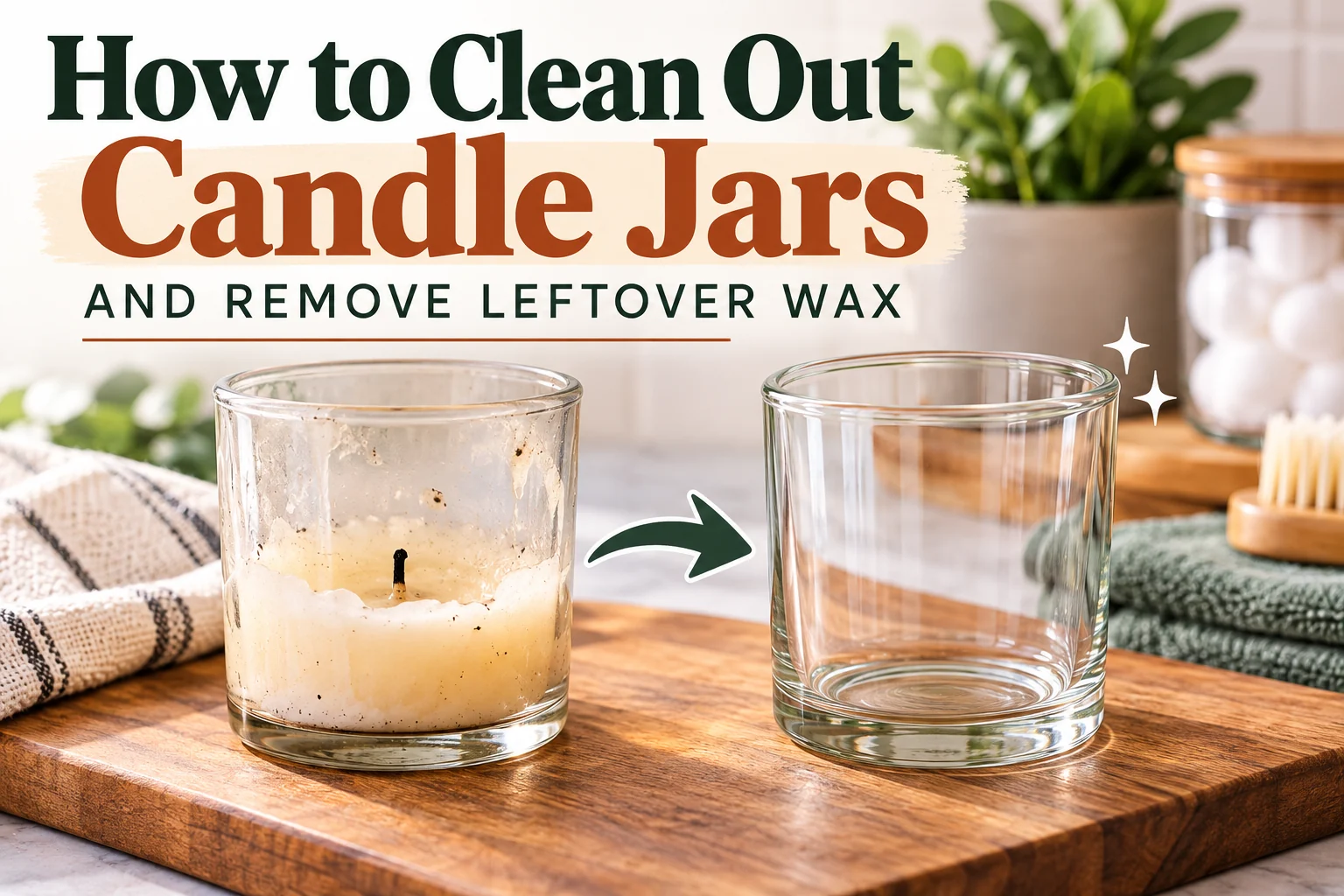
Finished burning your favorite candle but still have a layer of wax stuck to the bottom of the jar? Before throwing that container away, consider cleaning it out. Many glass candle jars can be reused for storage, organization, or decorative projects once the leftover wax and wick hardware are removed.
Learning how to remove wax from candle jars is easier than you might think. In many cases, a freezer, a little patience, and some warm soapy water are all you need. More stubborn residue may respond to gentle heat, but not every candle container can withstand rapid temperature changes.
This guide covers four common wax-removal methods, explains which ones are worth trying, and walks you through cleaning away remaining wax, wick tabs, and sticky fragrance residue.
Quick Answer: How Do You Get Wax Out of a Candle Jar?
Let the jar cool completely, then place a sturdy, undamaged glass candle jar in the freezer for approximately one to two hours. As the wax contracts, it may release from the glass. Gently loosen the hardened wax with a wooden or plastic utensil, remove the wick tab, and wipe out any residue. Finish by washing with warm water and dish soap once the glass has returned to room temperature.
Best starting method: Freezing is often the simplest option for jars containing a substantial layer of hardened wax.

Why Does Wax Stick to Candle Jars?
When a candle burns, molten wax forms around the wick and gradually fuels the flame. Eventually, the wick becomes too short to continue burning properly, leaving some wax behind.
As the candle cools, the remaining wax solidifies against the container. Depending on the type of wax, the container’s shape, and the cooling conditions, the wax may cling tightly to the glass.
Several factors affect how easily it comes out:
- Wax type: Soy, paraffin, beeswax, and blended waxes can differ in hardness and adhesion.
- Container shape: Straight-sided jars usually make removing solid wax pieces easier than narrow-necked containers.
- Wax thickness: A substantial layer may release as one piece, while a thin coating can be more difficult to wipe away.
- Wick adhesive: Metal wick tabs are commonly secured with adhesive that remains after the wax has been removed.
- Fragrance residue: Scented candles may leave an oily film inside the container.
Choosing the right cleaning technique depends on the jar and the amount of wax remaining.
What You’ll Need to Clean Out a Candle Jar
Most of the supplies required are everyday household items.
- Empty candle jar, fully cooled
- Freezer space
- Wooden craft stick or plastic scraper
- Paper towels
- Dish soap
- Soft sponge or cleaning cloth
- Warm water
- Protective gloves when handling warmed containers
- Optional: household hair dryer with a low-heat setting
If you’re planning to move from recycling and reusing candles into making your own, visit our basic materials needed to make homemade candles guide for a complete beginner supply checklist.
Four Methods for Removing Wax From Candle Jars
There isn’t one perfect cleaning method for every candle container. Below are four approaches you may encounter, including which methods are generally preferable and which require additional caution.
How to Remove Candle Wax Using the Freezer
Freezing can help hardened wax contract and pull away from the sides of a jar. It works particularly well when a substantial amount of solid wax remains.
Step-by-Step Instructions
- Let the jar cool completely. Never move a recently burning or warm candle directly into the freezer.
- Inspect the glass. Avoid using damaged, cracked, antique, or especially delicate containers.
- Place the jar upright in the freezer. Leave it for approximately one to two hours, or longer if needed.
- Check the wax. Look for separation between the hardened wax and the container.
- Loosen it gently. Use a wooden craft stick or a plastic scraper rather than a sharp metal blade.
- Remove the wax pieces. Dispose of them appropriately or save suitable clean wax for a non-burning craft project.
- Let the jar return to room temperature. Only then proceed with warm-water cleaning.
Best for: Straight-sided, sturdy glass jars containing relatively thick layers of hardened wax.
Potential limitation: Soft or sticky wax blends may not separate cleanly, and the method may be less effective on thin coatings.
How to Remove Wax With Warm Water
Gentle warmth can soften some types of candle wax, making leftover material easier to lift or wipe away.
This method is different from pouring boiling water straight into a glass jar. Sudden temperature changes can crack glass, especially when the container’s heat tolerance is unknown.
Step-by-Step Instructions
- Allow the jar to reach room temperature.
- Check that the container has no cracks, chips, or damaged decorative finishes.
- If the manufacturer permits warm-water cleaning, add comfortably warm, not boiling, water.
- Allow the water to gently soften the remaining wax.
- Remove loosened wax with a wooden or plastic utensil.
- Collect all floating or softened wax before disposing of the water.
- Wipe the container thoroughly with paper towels.
Best for: Small amounts of residue in intact jars approved for warm-water cleaning.
Potential limitation: Warm water may not be hot enough to melt certain hard waxes. Don’t compensate by exposing unknown glass to boiling water.
Can You Remove Candle Wax in the Oven?
Some candle-cleaning tutorials suggest heating jars in an oven to melt the remaining wax. Although this technique can melt wax, it introduces avoidable risks.
Most decorative candle jars are not documented as oven-safe. A jar that tolerated a burning candle is not necessarily designed for the heating conditions of a kitchen oven.
Potential problems include:
- Glass cracking from thermal stress
- Overheating adhesive or decorative coatings
- Spilled molten wax creating a fire or cleanup hazard
- Burn injuries when handling hot containers
For ordinary candle jars, the freezer method or carefully controlled low-heat cleaning is a better starting point.
Only consider oven exposure if the container manufacturer explicitly approves it for that use and provides appropriate instructions. Otherwise, skip this method.
How to Remove Leftover Wax With a Hair Dryer
A household hair dryer on a low setting may help soften thin areas of wax left behind after the main pieces have been removed.
This method works best on sturdy, intact containers without delicate coatings, labels, or decorations that could be affected by heat.
Step-by-Step Instructions
- Place the room-temperature jar on a stable, protected surface.
- Set the hair dryer to a low-heat setting.
- Keep the dryer at a safe distance and move the airflow gradually across the wax rather than concentrating heat on one small spot.
- Stop heating as soon as the wax begins to soften.
- Carefully wipe away the residue using paper towels.
- Repeat gently if necessary, allowing the glass to cool between attempts.
Best for: Small patches of residual wax on plain, intact glass that can tolerate gentle warming.
Potential limitation: The glass itself can become hot. Avoid high heat and stop immediately if the container becomes excessively warm or shows signs of damage.
Which Candle Wax Removal Method Works Best?
| Method | Best Use | Main Concern |
|---|---|---|
| Freezer | Thicker layers of hardened wax | Fragile jars and excessive scraping |
| Warm water | Small amounts of residue | Thermal shock and plumbing clogs |
| Oven | Not recommended for ordinary candle jars | Glass breakage and hot wax |
| Hair dryer | Thin wax films | Localized overheating |
Our recommendation: Start with freezing for substantial leftover wax. Afterward, clean small amounts of remaining residue with gentle wiping and warm soapy water. Use additional heat only where the container is suitable for it.
How to Remove the Metal Wick Holder From a Candle Jar
After the leftover wax comes out, you may notice a small metal disc attached to the bottom of the glass. This is the wick tab, sometimes called a wick sustainer.
Candle manufacturers typically attach this component using adhesive designed to keep the wick positioned during production and burning.
Removing the Wick Tab
- Make sure the jar is empty, cool, and stable.
- Try gently lifting an exposed edge with a wooden or plastic tool.
- If the tab releases, remove the entire metal piece.
- If it remains firmly attached, do not force it or pry against the glass.
- Stop if the container appears scratched, cracked, or damaged.
Some wick adhesives are difficult to remove completely. In those cases, it may be better to select a different storage or decorative use for the container rather than risk damaging the glass.
How to Clean Sticky Wax Residue From Glass Candle Jars
Even after the wax has been removed, candle jars can retain oily fragrance residue, small wax particles, or adhesive marks.
Use this finishing process:
- Wipe first: Remove as much visible wax and oil as possible with paper towels.
- Wash gently: Clean the room-temperature container using warm water, dish soap, and a soft sponge.
- Repeat if necessary: Heavily fragranced candles may require another wash to remove oily residue.
- Inspect: Check around the base and inside corners for remaining wax or adhesive.
- Dry completely: Allow the jar to air-dry or use a lint-free cloth.
For stubborn exterior label adhesive, try a small amount of an adhesive remover approved for the glass and its finish. Follow the product directions, wash off residue, and avoid using solvents near flames or other ignition sources.
How to Remove Candle Labels Without Damaging the Jar
Removing the original product label can make an old candle jar look considerably cleaner.
For paper labels:
- Carefully peel away as much of the label as possible.
- If the finish permits it, soften remaining paper with warm soapy water.
- Use your fingers or a plastic scraper to remove loose material.
- Clean remaining adhesive with an appropriate glass-safe product.
- Wash and dry the jar before placing anything inside it.
Printed, painted, frosted, and coated jars require extra caution because cleaning products and abrasion can damage their finish.
Can You Reuse Candle Jars After Cleaning?
Often, yes. A clean candle jar can make a useful container for non-burning household projects, provided it is undamaged and suitable for its new purpose.
Some simple ideas include:
- Storing cotton balls or cotton swabs
- Organizing pens and pencils
- Holding craft supplies
- Displaying decorative stones or shells
- Creating a small plant display with proper drainage considerations
- Organizing makeup brushes
However, a reused candle jar should not automatically be considered food-safe or suitable for creating another burning candle.
For additional inspiration, our planned guide to repurposing candle jars
Can You Make a New Candle in an Old Candle Jar?
It may be possible in some cases, but cleaning the jar is not enough to establish that it is safe for another candle.
Glass can be weakened by scratches, repeated heating, impacts, or thermal stress. Even if the container looks intact, its original manufacturer may not approve refilling.
For reliable homemade candles, it is better to use a new, documented candle-rated container and test the complete wax, wick, fragrance, and vessel combination.
Our beginner candle-making materials guide
What Should You Do With Leftover Candle Wax?
Small amounts of unused candle wax don’t necessarily have to go straight into the trash.
Depending on the condition of the wax, you may be able to save clean, uncontaminated pieces for testing colors or making other non-burning wax crafts.
Keep these guidelines in mind:
- Never pour liquid wax into drains.
- Don’t assume leftover scented wax is suitable for a new wick-based candle.
- Avoid reusing wax contaminated with soot, wick debris, adhesive, or cleaning products.
- Do not mix unknown wax types and assume the resulting blend will burn safely.
- Dispose of unsuitable wax in accordance with local waste rules.
If you’re interested in melting clean candle-making wax for a new project, read our double boiler for candle making guide
Common Mistakes When Cleaning Candle Jars
1. Pouring Melted Wax Down the Sink
Wax may solidify inside drainpipes and cause blockages. Remove it first and dispose of it separately.
2. Putting a Warm Jar in the Freezer
Rapid temperature changes can stress the glass. Always let the container reach room temperature before chilling it.
3. Using Sharp Metal Tools
Knives and screwdrivers can scratch or crack glass. Choose nonmetal tools and avoid applying excessive force.
4. Heating Unknown Glass in the Oven
Most candle jars are not labeled as oven-safe cookware. Oven heating is not a suitable default cleaning method.
5. Using Too Much Heat
Strong, concentrated heat can damage labels, coatings, adhesives, and even the glass itself.
6. Refilling Every Clean Jar With New Candle Wax
A clean container is not necessarily an approved refillable candle container. For new candles, choose documented candle vessels and perform burn tests.
Frequently Asked Questions
What is the easiest way to remove wax from candle jars?
The freezer method is often the easiest starting point. Allow the jar to cool completely, freeze it for approximately one to two hours, and gently lift out the hardened wax using a nonmetal utensil.
How do you get candle wax out of a glass jar without breaking it?
Use gentle methods and avoid rapid temperature changes. Never strike the glass or force sharp tools under the wax. Stop if the jar is cracked, chipped, or otherwise damaged.
Can you use boiling water to remove candle wax?
Although boiling-water techniques appear in many tutorials, pouring boiling water into ordinary candle jars can cause thermal shock. Gentle warm-water cleaning is a more conservative option when the manufacturer permits it.
Will vinegar remove candle wax?
Vinegar is not an effective primary method for dissolving candle wax. Removing the solid wax first, then cleaning the remaining residue with dish soap and warm water, is generally more practical.
Can you put candle jars in the dishwasher?
Do not assume decorative candle jars are dishwasher-safe. Labels, painted finishes, adhesives, and unknown glass specifications can make machine washing unsuitable. Handwashing is the better default unless the manufacturer says otherwise.
How do you remove the remaining wax from a Bath & Body Works candle jar?
After the jar has cooled completely, a freezer method may help release the wax. Avoid forcing the wax loose or subjecting the container to sudden temperature changes. Follow any container-specific cleaning guidance from the manufacturer.
Can you reuse candle jars for food storage?
Do not assume a candle container is approved for food contact. Unless the manufacturer confirms the jar and its finishes are food-safe, use it for nonfood storage or decoration instead.
How do you remove the smell from an empty candle jar?
Wipe away wax and fragrance residue, then wash with warm water and dish soap. Some fragrances may continue to linger, particularly in porous lids or decorative components.
Final Thoughts: Give Your Candle Jars Another Life
Learning how to clean out candle jars is a practical way to reduce unnecessary waste and get more value from containers you already own.
For most ordinary candle jars, the easiest approach is to start with the freezer method, remove the hardened wax carefully, and finish with warm soapy water. Thin residue may require additional gentle cleaning, but oven heating and sharp scraping tools are rarely worth the added risk.
Once your jar is clean and dry, it can become a useful organizer, storage container, or decorative accessory.
And if cleaning out an old candle inspires you to make your own, start with the right materials and a documented candle-safe container rather than automatically refilling the old glass.
Leave a Reply