
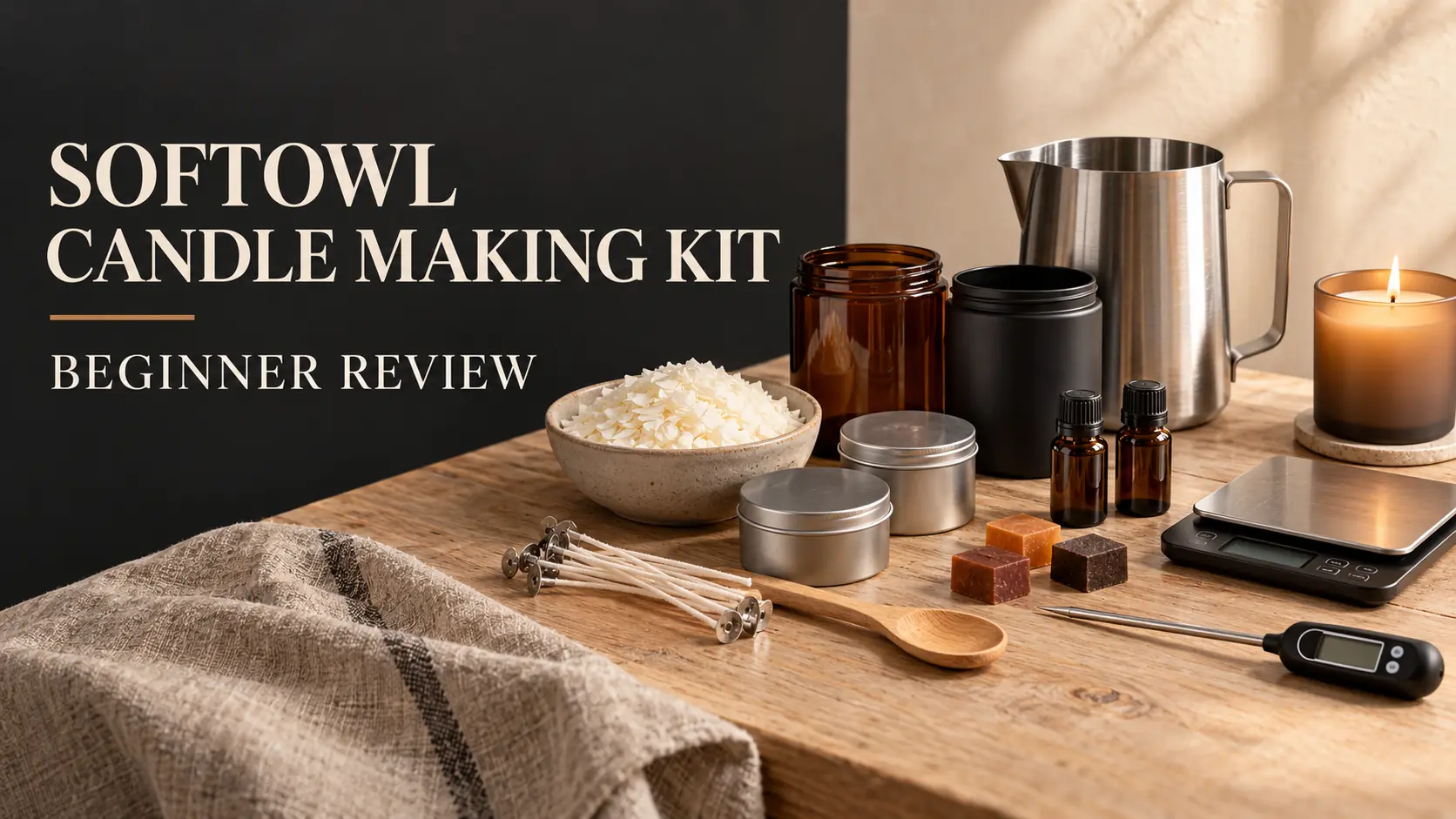
Beginner kit buying guide
Is the SoftOwl candle making kit a good place to begin?
The SoftOwl soy candle making kit bundles the core ingredients, vessels, and tools needed for a first batch. Here is what the set does well, what beginners may still need, and the safety details that deserve attention before the wax melts.
Check availability on AmazonThe short answer
A convenient first-project kit.
Broad enough for experimenting, but not a substitute for measuring, burn testing, or learning why the components work together.
The SoftOwl candle making kit is best for a beginner who wants a coordinated, giftable introduction to scented container candles. It removes much of the initial sourcing work by combining soy wax, multiple vessels, fragrance oils, colorants, wicks, and basic pouring tools.
Its breadth is also its limitation. A general starter kit cannot provide every wick size, testing tool, or technical specification a maker will eventually need. Treat the first candles as learning batches—not automatically as finished products ready to sell.
Product overview
What is the SoftOwl soy candle making kit?
The SoftOwl kit is an all-in-one craft set built around soy container candles. Instead of asking a beginner to select wax, vessels, fragrance, dye, wicks, adhesive, and pouring tools separately, the package brings those categories together for a guided first experience.
That makes the kit appealing when convenience matters more than complete control. It can reduce the uncertainty of a first supply order and create several opportunities to experiment with vessel styles, scent choices, and color. The packaging also makes it a practical creative gift.
The kit should still be approached as an introduction to candle making. Candle performance depends on the relationship among the wax, wick, fragrance, dye, and vessel. Even when those pieces arrive in the same box, the finished candles should be tested and observed carefully.
| Brand | SoftOwl |
|---|---|
| Kit type | Beginner soy container-candle kit |
| Wax | Pre-portioned packs of soy wax are listed; confirm the current quantity on Amazon. |
| Vessels | Jars and metal tins; the listing describes larger jars as 7-ounce vessels. |
| Scent and color | Seven fragrance oils and ten dye blocks are listed. |
| Basic tools | Wicks, glue dots, labels, pipettes, a stirring spoon, and a wax melting pot are among the listed components. |
| Best use | Learning the container-candle process and making small personal or gift batches. |
| Current price | Check Amazon. Price and availability can change, so they are not reproduced here. |
Listing reminder: Amazon sellers can revise packaging and included quantities. Compare the current “About this item” section and product images with this guide before ordering.
Inside the box
What does the SoftOwl candle making kit include?
The kit’s main advantage is variety. It covers most of the physical categories needed to make scented, colored container candles without sending a beginner to several suppliers.
Soy wax
Pre-portioned wax is easier to organize than starting with a large bulk case. The portions also make it simpler to reserve material for several small experiments.
Jars and tins
Using both vessel styles allows a beginner to see how glass and metal containers differ during setup, cooling, and use. Verify the exact vessel count in the current listing.
Seven fragrance oils
Multiple scents make the project more creative and give the maker room to compare fragrance character. Use only the amount directed by the kit or oil supplier.
Ten dye blocks
Dye blocks are intended to color wax without introducing water. Use a light hand because too much dye can affect wick performance.
Wicks and glue dots
The adhesive helps secure the wick tab to the vessel before pouring. Centering and final wick suitability still need to be checked.
Melting and mixing tools
The listed melting pot, pipettes, and stirring spoon cover basic handling tasks. The pot should be heated indirectly in a water bath unless the instructions expressly state otherwise.
Labels and finishing pieces
Labels make the candles feel gift-ready and can help identify scent or batch. They do not replace a proper caution label when a candle will be given away.
Printed guidance
Follow the instructions included with the current kit, especially its wax temperatures, fragrance quantities, pour guidance, and cooling recommendations.
If you are still deciding whether a kit or individual supplies make more sense, read our guide to the basic materials needed to make homemade candles.
Complete the workspace
What might you still need?
“All in one” does not always mean that every tool needed for accurate, repeatable candle making is included. Check the current package contents, then add the following items if they are not supplied:
- A digital scale: Wax and fragrance should be measured by weight, not by drops, spoonfuls, or the apparent volume of a jar.
- A reliable thermometer: Track the wax temperature and follow the kit’s instructions rather than guessing by appearance.
- A saucepan for a water bath: A pouring or melting pitcher generally belongs inside a controlled double-boiler setup—not directly on an exposed burner.
- Heat-resistant gloves and surface protection: Hot wax, hot water, and metal tools can cause burns or damage countertops.
- Wick-centering tools: A centered wick supports a more even test burn. Clothespins or purpose-made bars can help.
- Additional wick sizes: One included wick style may not be ideal for every supplied vessel and fragrance combination.
- A notebook or batch sheet: Record vessel, wax weight, fragrance amount, dye, temperatures, cure time, and burn observations.
- Caution labels: Use suitable candle warning labels if finished candles will be gifted.
Use the candle wax calculator when you need to plan wax by container count and fill weight in ounces or grams.
First project plan
How should a beginner use the kit?
Start smaller than the maximum batch. One or two test candles allow you to learn the wax and fragrance without committing all the materials at once.
Read the complete instructions
Identify the recommended wax temperature, fragrance quantity, pour temperature, cooling time, and any precautions before turning on the heat.
Prepare one vessel
Inspect the jar or tin, clean it as directed, secure the wick tab at the center, and support the wick from above so it remains upright.
Measure the wax by weight
Use a digital scale. If the kit provides pre-measured portions for a specific vessel, keep that pairing for the first project.
Melt with indirect heat
Use a stable water-bath setup and monitor the wax with a thermometer. Never leave heating wax unattended.
Add scent and color as directed
Do not improvise with extra fragrance. Too much oil or dye can create poor burning, seepage, or an unstable candle.
Pour and cool undisturbed
Set the vessel on a protected, level surface away from children, pets, drafts, and water. Keep the wick centered while the candle sets.
Cure before testing
Follow the wax or kit guidance. Soy candles commonly benefit from a longer cure than a single day, especially when evaluating fragrance performance.
Trim, test, and record
Trim the cooled wick to roughly 1/4 inch unless the kit specifies otherwise. Test in controlled sessions and record flame, melt pool, soot, mushrooming, vessel heat, and self-extinguishing behavior.
For a broader explanation of how wax choice changes the process, see how to choose the right candle wax. Our guide to different wick types explains why the included wick is only a starting point.
Do not skip this section
Important safety guidance
Keep dried flowers and loose decoration out of burnable candles
Some versions, images, or descriptions of craft kits may show dried flowers or botanicals. Do not place dried petals, herbs, leaves, paper, glitter, crystals, or other loose objects near the wick or where the melt pool can carry them toward the flame. Combustible decoration can become a secondary wick and create a dangerously large or unpredictable flame.
If decorative botanicals are included, use them for a separate non-burning craft or display them outside the candle vessel. A candle intended to be lit should have a clear wax surface around the wick.
- Never melt wax directly over an open flame or leave heating wax unattended.
- Keep water out of melted wax. Water can sputter when heated and does not blend into candle wax.
- Do not substitute food coloring, crayons, perfume, random essential oils, or craft pigments for candle-rated materials.
- Keep hot wax and lit candles away from children and pets. Family projects require continuous adult supervision.
- Use candles only on a stable, heat-resistant surface away from drafts and combustible items.
- Do not burn a candle for longer than the vessel or kit instructions allow, and stop using it before the flame reaches the bottom.
- Discontinue a candle if the vessel becomes excessively hot, cracks, smokes heavily, develops an unusually high flame, or shows other unstable behavior.
- Test every new formula through its full usable life before gifting it. A good first burn does not guarantee safe performance later.
Our article on common candle-making mistakes covers additional problems beginners can prevent.
Balanced assessment
SoftOwl kit advantages and limitations
What the kit does well
- Combines the main supply categories in one order.
- Offers multiple vessels, scents, and colors for creative variety.
- Reduces sourcing decisions for a first-time maker.
- Includes basic melting, stirring, and assembly pieces.
- Feels more gift-ready than a collection of separate supply packages.
- Leaves room for several small experiments rather than one fixed design.
Where it is limited
- May not include a digital scale, thermometer, or enough wick sizes for systematic testing.
- Technical specifications may be less detailed than those from specialist candle suppliers.
- Small fragrance containers may limit repeated formula testing.
- A broad kit cannot optimize every wick, scent, dye, and vessel combination.
- Decorative botanicals, if included, should not be placed near a candle flame.
- Included tools are intended for learning—not ongoing production.
Who it fits
Should you buy the SoftOwl candle making kit?
Consider it if you:
- Have never made a candle and want most of the first-project supplies in one box.
- Prefer creative variety over developing one highly controlled formula.
- Want a candle-making gift that looks more complete than individually sourced components.
- Plan to make personal-use candles while learning basic measuring, melting, pouring, and testing.
- Are willing to add a scale, thermometer, or alternate wicks when needed.
Skip it and buy supplies separately if you:
- Already know the exact wax, vessel, wick series, and fragrance you want to test.
- Need detailed technical documentation from a specialist supplier.
- Plan to manufacture candles for sale immediately.
- Need larger quantities, replacement components, or consistent repeat ordering.
- Want to compare several wick sizes in one standardized vessel.
Our view: The SoftOwl kit makes the most sense as an approachable learning experience. It offers enough variety to keep a first session interesting, but serious makers will eventually move toward individually sourced wax, wick series, vessels, and fragrance oils with fuller technical documentation.
Ready to check the current package?
Review the latest contents, seller information, price, delivery date, and return terms directly on Amazon before ordering.
Check the SoftOwl kit on Amazon Paid link. Price and availability may change.Before you order
SoftOwl kit buying checklist
Because marketplace listings and package configurations can change, confirm the following on the current product page:
- The exact number and size of jars and tins
- The total wax quantity and whether it is divided into portions
- The current fragrance names and oil quantities
- The number of wicks and whether more than one size is supplied
- Whether a thermometer, digital scale, or wick-centering tools are included
- Whether instructions specify wax, fragrance, and pouring temperatures
- Current seller, shipping, return, and warranty information
- Whether package photos show decorative botanicals that should remain outside burnable candles
Do not base the decision on the product title alone. Compare the full component list with the tools you already own and the candles you actually want to make.
Continue learning
Build the skills behind the kit.
Frequently asked questions
SoftOwl candle making kit FAQ
Is the SoftOwl candle making kit good for beginners?
Yes, it is designed as a broad beginner set and includes most of the main supply categories for scented soy container candles. Beginners should still use a scale and thermometer, follow the current instructions, and burn-test each finished formula.
How many candles does the SoftOwl kit make?
The answer depends on the exact package version, current wax quantity, vessel sizes, and how the wax is divided. Check the current Amazon component list rather than relying on an older review or package photo.
Can I put the dried flowers in the candles?
Do not place dried flowers, herbs, leaves, paper, or other combustible decoration near the wick or where the liquid melt pool can carry it toward the flame. Use botanicals for a separate non-burning craft or display them outside the candle vessel.
Does the kit include everything I need?
It includes the core wax, vessel, fragrance, dye, wick, adhesive, and basic-tool categories. Depending on the current version, you may still need a digital scale, thermometer, water-bath saucepan, heat protection, wick-centering tools, alternate wick sizes, and caution labels.
Can children use this candle-making kit?
Candle making involves hot wax, hot water, heated metal, fragrance materials, and later an open flame. Children and teens need continuous, hands-on adult supervision, and the adult should control all heating and pouring steps.
How long should the soy candles cure?
Follow the instructions supplied with the kit or wax. Many soy container candles develop better fragrance performance after roughly one to two weeks, but the appropriate cure period depends on the specific wax and formula.
Can I sell candles made with the kit?
The kit can teach the process, but do not assume a candle is ready to sell because it looks good. A commercial formula needs documented measurements, repeatable sourcing, suitable labeling, full-life burn testing, business insurance, and compliance with applicable requirements.
Are Amazon prices or ratings shown in this review?
No. Prices, availability, sellers, ratings, and package configurations can change. Use the Amazon link to view the current purchasing information.
Leave a Reply