
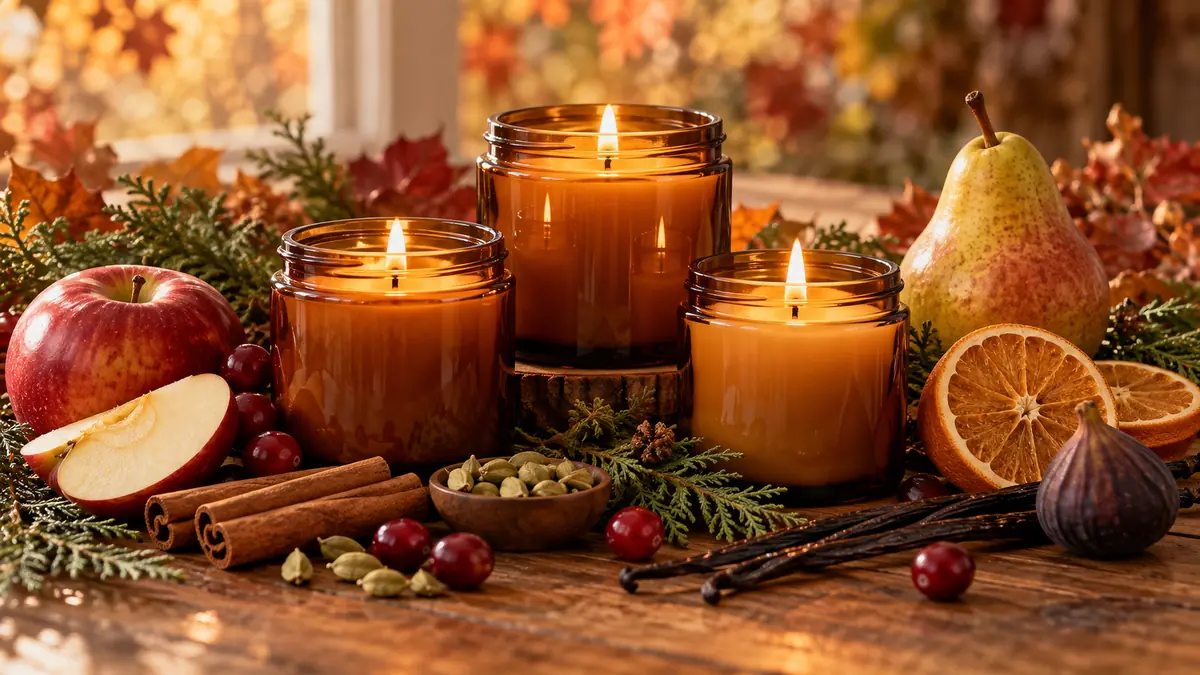
Autumn Fragrance Library
The best fall candle scent combinations do more than repeat pumpkin spice. They balance familiar seasonal notes with fruit, woods, herbs, smoke, amber, or creamy sweetness so the finished fragrance feels warm, recognizable, and distinctive.
Quick answer: Reliable fall pairings include apple and cedar, pear and cardamom, pumpkin and chai, vanilla and sandalwood, fig and amber, cranberry and orange, maple and pecan, or marshmallow and smoke. Begin with a simple two- or three-oil ratio, evaluate it on scent blotters, then make a small candle test using oils approved for candle applications.
How to Read the Blend Ratios
Every ratio below describes the fragrance blend itself. It does not tell you how much total fragrance to add to the wax. For example, a 3:1 apple-to-cedar blend contains three parts apple fragrance oil and one part cedar fragrance oil. If you made 20 grams of that fragrance blend, you would use 15 grams of apple and 5 grams of cedar.
Important: A blend ratio is not a fragrance-load recommendation. The finished candle must remain within the limits for the wax, every fragrance oil, and the intended candle application. Use the lowest applicable limit and confirm performance through complete burn testing.
The formulas are creative starting points because fragrance oils with the same name can smell very different. One supplier’s apple may be crisp and green; another may already contain cinnamon, caramel, or pastry notes. Smell each oil alone before deciding whether the starting ratio needs adjustment.
If you are new to combining oils, first read How to Blend Fragrance Oils for Candles. The companion guide to candle fragrance families explains why neighboring families often harmonize while contrasting families create more tension.
Lead note
The scent shoppers recognize first: apple, pumpkin, fig, coffee, cedar, or another clear theme. Give it the largest share when you want an easy-to-understand candle.
Supporting note
A complementary scent that adds warmth, lift, creaminess, or contrast without competing with the lead.
Accent note
A smaller amount of spice, smoke, herb, citrus, leather, or earth that gives the fragrance a memorable edge.
Base note
A deeper material such as amber, vanilla, sandalwood, cedar, musk, or patchouli that can make the blend feel grounded and lasting.
Fruity Fall Candle Scent Combinations
Orchard and berry fragrances create an immediate autumn connection without making every candle smell like dessert. Woods, herbs, amber, and restrained spice keep fruit blends dimensional.
| # | Blend idea | Starting ratio | Character and adjustment |
|---|---|---|---|
| 1 | Apple Orchard and Cedar | 3 apple : 1 cedar | Crisp fruit meets dry wood. Increase cedar for a rustic cabin direction or keep apple dominant for broader appeal. |
| 2 | Pear, Cardamom, and Vanilla | 4 pear : 1 cardamom : 1 vanilla | Soft, elegant, and gently spiced. Vanilla rounds the pear while cardamom adds warmth without turning the blend into a bakery scent. |
| 3 | Cranberry, Orange, and Clove | 3 cranberry : 2 orange : 1 clove | Tart and bright with a warm finish. Clove oils can dominate, so begin below one full part if the material is especially strong. |
| 4 | Fig and Amber | 2 fig : 1 amber | Rich fruit with a smooth, resinous base. This is a strong choice for a sophisticated fall collection that avoids obvious spice. |
| 5 | Blackberry and Sage | 3 blackberry : 1 sage | Dark berry balanced by an aromatic green note. Add more sage cautiously; it should sharpen the fruit rather than smell medicinal. |
| 6 | Plum, Patchouli, and Vanilla | 4 plum : 1 patchouli : 1 vanilla | Deep and velvety. Patchouli supplies earthiness, while vanilla softens the edges and makes the blend easier to live with. |
Blending tip: When a fruit fragrance feels thin or candy-like, first try a small amount of wood, amber, tea, herb, or musk. Adding more spice is not the only way to make fruit feel autumnal.
Pumpkin, Bakery, and Gourmand Fall Blends
Gourmand fragrances resemble edible treats, but the best versions still have structure. A dry wood, coffee note, salt accord, restrained spice, or touch of smoke can prevent a sweet candle from becoming flat.
| # | Blend idea | Starting ratio | Character and adjustment |
|---|---|---|---|
| 7 | Pumpkin and Chai | 3 pumpkin : 1 chai | Familiar pumpkin with layered tea spice. Check both oils first because many pumpkin fragrances already contain cinnamon and clove. |
| 8 | Pumpkin, Maple, and Pecan | 3 pumpkin : 1 maple : 1 pecan | Nutty and dessert-like. Reduce maple if the first blotter test becomes syrup-heavy. |
| 9 | Apple, Caramel, and Sea Salt | 3 apple : 2 caramel : 1 sea salt accord | A caramel-apple profile with a contrasting mineral accent. Use a candle-formulated sea salt fragrance accord, not actual salt. |
| 10 | Cinnamon Roll and Coffee | 3 cinnamon roll : 1 coffee | Warm bakery sweetness with a roasted edge. Choose a coffee oil that does not overpower the pastry note. |
| 11 | Vanilla, Bourbon, and Oak | 3 vanilla : 2 bourbon accord : 1 oak | Warm, mellow, and grown-up. A bourbon fragrance accord creates the impression; never add drinking alcohol to candle wax. |
| 12 | Maple, Coffee, and Pecan | 2 coffee : 1 maple : 1 pecan | A fall cafe blend that leads with roast rather than sugar. Increase pecan for a softer, nuttier drydown. |
| 13 | Brown Sugar, Tonka, and Cinnamon | 4 brown sugar : 2 tonka accord : 1 cinnamon | Deep sweetness with a warm spice accent. Start lower with an intense cinnamon oil and respect all supplier limits. |
Sweet fragrances are popular, but a product line needs contrast. Compare seasonal demand, scent naming, and assortment choices in Top Candle Scents and Styles for Maximum Sales.
Woody, Smoky, and Atmospheric Fall Blends
These combinations evoke libraries, campfires, forest walks, worn leather, and cool evenings. They work especially well when the collection needs a less-sweet option.
| # | Blend idea | Starting ratio | Character and adjustment |
|---|---|---|---|
| 14 | Cedar and Amber | 2 cedar : 1 amber | Dry wood wrapped in smooth warmth. This versatile base can also accept a small fruit or smoke accent. |
| 15 | Sandalwood and Vanilla | 2 sandalwood : 1 vanilla | Creamy wood with restrained sweetness. It suits an understated collection and transitions easily into winter. |
| 16 | Tobacco, Honey, and Cedar | 3 tobacco accord : 1 honey : 1 cedar | Warm, golden, and dry rather than sugary. Use a candle fragrance named tobacco, not tobacco leaf or material intended for smoking. |
| 17 | Marshmallow and Bonfire Smoke | 4 marshmallow : 1 smoke | A campfire-inspired gourmand. Smoke oils can be forceful, so add them in small measured increments. |
| 18 | Leather, Cedar, and Apple | 2 leather : 2 cedar : 1 apple | A study or saddle-room mood with a subtle orchard lift. Increase apple if the first version feels too dark. |
| 19 | Fallen Leaves, Oakmoss, and Amber | 3 fallen leaves : 1 oakmoss accord : 1 amber | Earthy, cool, and atmospheric. This is a useful anchor for a nature-focused autumn line. |
| 20 | Pine, Cedar, and Apple | 2 pine : 2 cedar : 1 apple | Forest-forward with just enough fruit to keep it from reading as a winter holiday scent. |
Remember: Fragrance names describe an aroma concept, not necessarily the literal ingredient. Smoke, bourbon, leather, sea salt, tobacco, oakmoss, and honey can all be professionally formulated fragrance accords designed for candles.
Fresh and Unexpected Fall Candle Scents
Not every autumn candle needs to smell heavy. Herbal, citrus, tea, and aromatic notes give customers a fresher choice while woods and amber maintain the seasonal mood.
| # | Blend idea | Starting ratio | Character and adjustment |
|---|---|---|---|
| 21 | Bergamot, Black Tea, and Fig | 2 black tea : 2 bergamot : 1 fig | Bright at first, then softly fruity and tannic. It feels polished without relying on bakery notes. |
| 22 | Sage, Eucalyptus, and Cedar | 3 sage : 1 eucalyptus : 2 cedar | Cool herbs over dry wood. Keep eucalyptus in a supporting role so the candle remains atmospheric rather than sharply medicinal. |
| 23 | Lavender, Amber, and Vanilla | 2 lavender : 2 amber : 1 vanilla | A calm evening blend with warmth underneath. It can serve customers who want autumn comfort without food or forest notes. |
How to Design Your Own Fall Fragrance Blend
A repeatable framework is more useful than randomly combining bottles. Begin with a mood and build from the lead note outward.
- Choose one scene. An orchard, bakery, rainy trail, fireside chair, harvest table, or cool morning gives the blend a clear direction.
- Select a lead family. Choose fruit, gourmand, wood, aromatic, amber, or fresh as the fragrance’s main identity.
- Add one supporting family. Pair fruit with wood, gourmand with roast, woods with amber, or herbs with citrus. Start with a simple 3:1 or 2:1 ratio.
- Decide whether an accent is necessary. A small amount of smoke, spice, tea, leather, or herb can create character. It should solve a problem, not merely make the ingredient list longer.
- Test on blotters. Weigh or count equal-size drops only for an early smell comparison. Let the strips rest together, then assess immediately, after several hours, and the next day.
- Convert the idea to weight. Once the ratio is promising, weigh the fragrance oils on an accurate scale. Record the supplier, oil name, lot, grams, and percentage of the fragrance blend.
- Make one small candle batch. Hold the wax, vessel, wick, dye, total fragrance percentage, mixing method, pour temperature, and cure time constant.
A simple ratio calculation
Suppose you want 24 grams of a 3:1 apple-and-cedar fragrance blend. The formula contains four total parts. Divide 24 grams by four to get 6 grams per part. Weigh 18 grams of apple and 6 grams of cedar.
Formula: Ingredient weight = total fragrance-blend weight x ingredient parts / total parts.
This calculation creates the fragrance mixture only. Use your documented candle formula to determine how much of that mixture belongs in the wax. The Candle Wax Calculator can help establish batch weights, but the exact wax and oil documentation still control the allowable amount.
From Blotter Test to Finished Candle
A blend that smells beautiful in the bottle may change in hot wax, after curing, or during combustion. Treat evaluation as a sequence rather than one sniff.
| Stage | What to evaluate | What to record |
|---|---|---|
| Oil alone | Strength, hidden notes, discoloration information, and whether one oil already contains several accords | Supplier, exact product name, lot, document dates, and first impression |
| Blotter blend | Balance immediately and after the most volatile notes fade | Ratio by parts, rest time, dominant note, and next adjustment |
| Cured candle | Cold throw, wax appearance, oil seepage, frosting, color change, and surface stability | Wax, fragrance percentage, mix temperature, pour temperature, and cure duration |
| Controlled burn | Hot throw, flame, melt pool, soot, wick carbon, vessel temperature, and changes lower in the jar | Session length, room conditions, observations, and remaining wax depth |
| Repeat batch | Whether the formula performs consistently rather than succeeding once | New batch and lot details, results, and any variation from the approved method |
Change one variable at a time
If the first candle has weak hot throw, do not simultaneously increase fragrance, enlarge the wick, change the wax, and shorten the cure time. That removes your ability to identify the cause. First verify the formula and process, then compare one controlled variation with the original.
Fragrance affects the fuel system. Even when two blends use the same total percentage, their viscosity, composition, color, and combustion behavior may differ. Revisit wick selection whenever the fragrance or its ratio changes. The guide to different candle wick types explains why a wick series and size must be tested in the complete formula.
How to Build a Balanced Fall Candle Collection
A focused seasonal line is easier to understand than a catalog of near-duplicates. Four to six fragrances can cover several preferences without overwhelming production.
One familiar hero
Choose pumpkin chai, caramel apple, or another instantly recognizable scent that signals fall.
One fruit-led option
Pear cardamom, blackberry sage, or fig amber adds seasonal character without repeating pumpkin.
One wood-led option
Cedar amber or sandalwood vanilla gives customers a warm scent that is not primarily sweet.
One atmospheric option
Fallen leaves, bonfire smoke, black tea, or leather can provide the distinctive story of the collection.
Name what the customer can actually smell
A poetic name can support the brand, but the product description should identify the recognizable fragrance direction. Instead of relying only on a name such as “October Light,” add a clear line such as “crisp apple, dry cedar, and warm amber.” Avoid promising wellness effects or calling a scent natural unless the composition and claim can be substantiated.
Work backward from the launch date
For fall search demand and seasonal shopping, aim to publish the guide or collection page by July. Product development needs to begin earlier so there is time for fragrance selection, wax testing, wick testing, repeat production, photography, labels, inventory, and listing preparation. A rushed August formula leaves little room to correct a candle that fails late in its burn.
- January through March: gather ideas and order small fragrance samples.
- March through May: make controlled fragrance and wick test batches.
- May through June: repeat successful formulas and finalize names, labels, and photography.
- July: publish educational content, collection previews, and early listings.
- August through October: promote, monitor reviews, and replenish only validated products.
If these candles will be sold, connect fragrance planning to the broader advice in the Candle Making Business hub. A seasonal idea becomes a viable product only after its materials, labor, packaging, testing, fees, and expected demand make sense together.
Fragrance Safety and Documentation
Use fragrance oils specifically identified by the supplier as suitable for candles. Obtain the current Safety Data Sheet and the supplier’s applicable conformity or use documentation for the intended product category. Keep those records with the exact product and lot information used in the formula.
The International Fragrance Association explains that a Certificate of Conformity is prepared by the fragrance-mixture supplier for a specified intended use. It confirms alignment with the IFRA Standards, but it does not replace a finished-product safety assessment or local legal compliance.
Follow the lowest relevant ceiling:
- The maximum fragrance percentage supported by the exact wax.
- The applicable limit supplied for every fragrance material in the blend.
- Any lower level required for stable appearance, acceptable burning, or reliable manufacturing.
More oil does not automatically create stronger hot throw. Excess fragrance may contribute to oil seepage, poor wick performance, unstable burning, or an unbalanced scent. Strong spice, smoke, herbal, and earthy materials often need less representation in the blend, even when a higher amount would be permitted.
Do not add pantry ingredients to the melt pool. Ground cinnamon, dried herbs, leaves, coffee grounds, fruit peel, and similar combustible decorations can interfere with the wick and introduce extra fuel near the flame. Create the aroma with candle-suitable fragrance materials instead.
Burn every candle on a stable, heat-resistant surface away from drafts and combustible items. Keep it within sight, follow the tested burn-time and trim instructions, and stop use if the flame becomes unsafe or the vessel is damaged. Review common formulation and testing failures in How to Avoid Common Candle-Making Mistakes.
Frequently Asked Questions
What candle scents smell most like fall?
Apple, pear, pumpkin, cranberry, fig, maple, vanilla, cinnamon, cardamom, clove, cedar, sandalwood, amber, fallen leaves, coffee, smoke, and leather are strongly associated with autumn. A convincing fall candle usually combines one recognizable seasonal note with a contrasting support such as wood, herb, citrus, tea, or roast.
What scents pair well with pumpkin?
Pumpkin pairs naturally with chai, maple, pecan, vanilla, coffee, sandalwood, amber, apple, and restrained baking spice. Check the pumpkin fragrance first because it may already contain several of those notes.
What is a good fall candle scent without cinnamon?
Try fig and amber, blackberry and sage, apple and cedar, sandalwood and vanilla, bergamot with black tea and fig, or fallen leaves with oakmoss and amber. These create warmth through woods, fruit, herbs, tea, and resinous notes rather than cinnamon.
Can I mix two finished fragrance oils together?
Yes, if both are documented by their suppliers for candle use and the finished blend remains within every applicable limit. Mixing them creates a new formula, so it must be weighed, recorded, tested in wax, and fully burn-tested.
How many fragrance oils should be in one candle blend?
Two or three oils are enough for many effective blends. More ingredients do not guarantee a better fragrance and can make testing, documentation, purchasing, and batch consistency harder. Add another oil only when it has a clear job.
Do blend ratios equal fragrance load?
No. A ratio describes how the fragrance oils relate to one another. Fragrance load describes how much total fragrance is used in the candle formula. Determine the blend first, then calculate an allowed total fragrance amount for the wax and all included oils.
Why does my blend smell different after curing?
Wax can change how individual notes are perceived, and volatile top notes may settle differently than heavier base notes. Cure time, wax chemistry, fragrance percentage, mixing, and temperature all influence cold and hot throw. Judge the formula in a cured candle, not only from the bottle.
When should I launch fall candles?
Many makers begin introducing fall collections in late summer, but development should start months earlier. Aim to have formulas tested, content prepared, and core product pages ready by July so the collection can build visibility before peak autumn interest.
Turn an Autumn Idea Into a Testable Formula
Choose one blend from the list, make a small blotter trial, and record every change. Once the balance works, move it into one controlled candle system and let the burn test decide whether the wax, wick, fragrance, and vessel belong together.
Learn how to blend candle fragrance oils or explore candle fragrance families.
This guide provides creative and educational starting points. Fragrance documentation, wax compatibility, product testing, labeling, insurance, and legal requirements remain the candle maker’s responsibility.
Leave a Reply