
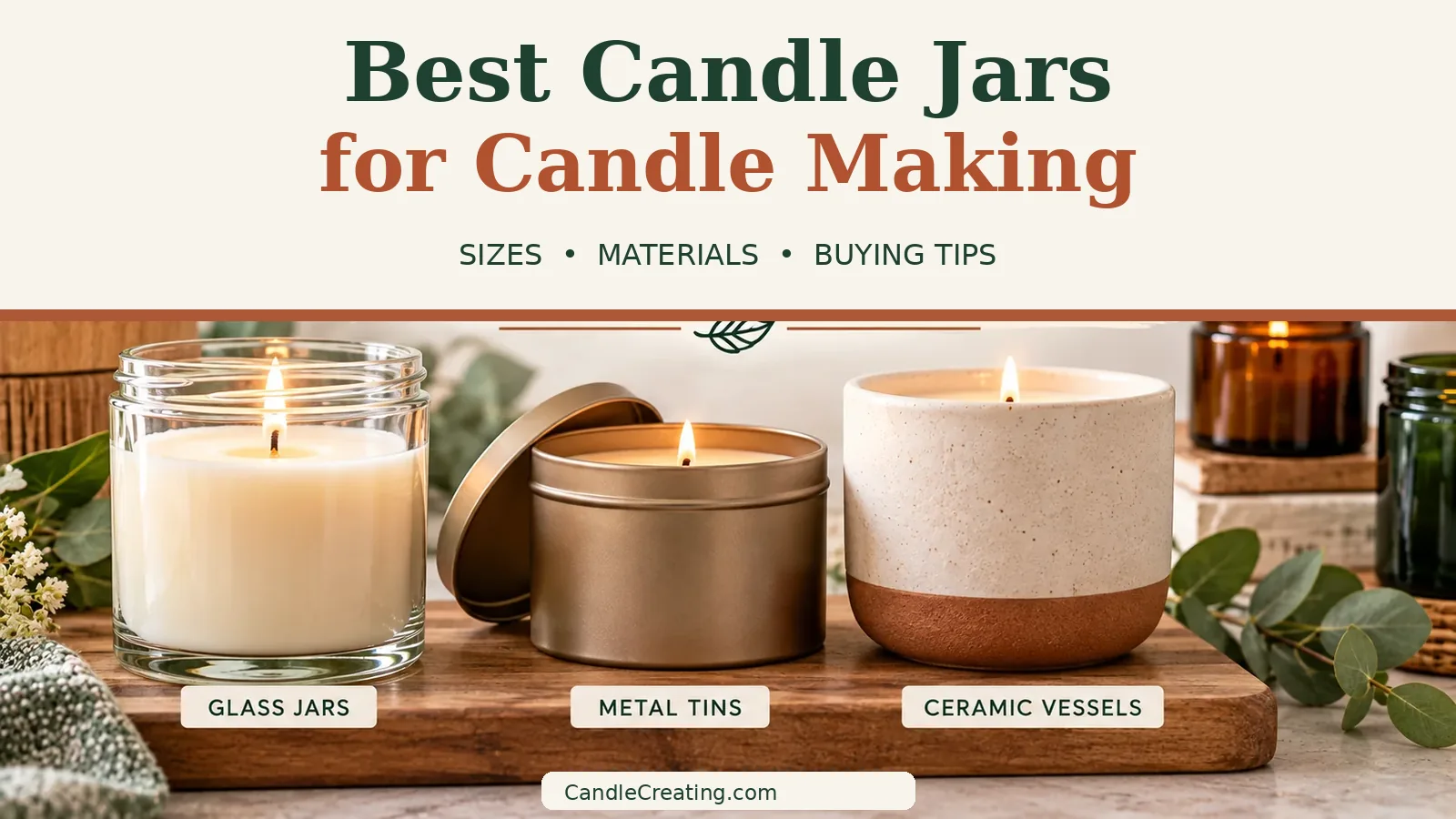
Choosing the best candle jars for candle making involves more than finding an attractive container. The right jar affects how your finished candle looks, how you select a wick, how much wax you’ll need, and how efficiently you can produce candles in batches.
Glass candle jars, decorative ceramic vessels, and metal candle tins all have their place. However, differences in capacity, inside diameter, lid styles, and manufacturing specifications can make one container much better suited to your project than another.
Whether you’re making your first soy candle, producing gifts, or sourcing candle jars in bulk for a small business, this guide explains how to choose containers that fit your needs.
We’ll compare popular jar sizes, explore different materials, look at three candle jar purchasing options, and discuss important buying considerations before you place a large order.
Quick Answer: What Are the Best Candle Jars for Making Candles?
For beginners, a straight-sided glass jar manufactured specifically for candle making is usually a practical starting point. An 8 oz nominal-capacity jar is a popular size because it is manageable for small batches, offers an attractive finished appearance, and is widely available from candle suppliers.
For gift candles, decorative amber or ribbed glass jars can provide a more distinctive appearance. For lightweight products, purpose-made metal candle tins may be convenient.
Most important: Choose documented candle-rated containers, match the wick to the actual inside diameter, and burn-test every finished candle formula.

What Makes a Good Candle Jar?
The best candle jar is one that fits your candle formula, intended use, and presentation while providing appropriate manufacturing documentation for candle use.
Before choosing a container, consider six important factors.
1. Documented Candle Use
Look for containers specifically manufactured for candle making. For applicable annealed glass candle containers, ASTM F2179 is an important standard to ask suppliers about.
Being made of thick glass or marketed as heat-resistant does not automatically establish suitability for candle burning.
For more detail, read our guide to heat-resistant candle jars and safe candle containers.
2. Inside Diameter
The inside diameter of a candle jar directly influences the initial wick selection. A wider container generally requires a different wick configuration than a narrow container holding the same wax weight.
Measure the internal diameter rather than relying only on the jar’s advertised capacity.
3. Container Capacity
Most candle jars are sold using a nominal ounce size. However, that label does not always describe the exact weight of wax that should be poured into the jar.
Understanding the difference between volume and wax weight helps prevent wasted supplies and incorrect batch calculations.
4. Jar Shape
Straight-sided jars tend to be easier to wick, label, package, and clean than containers with complex shapes or narrow openings.
5. Lid Style
Wood, metal, and other lid designs can affect the appearance and packaging of your candle. A properly fitting lid can also help protect the candle surface from dust during storage.
Remove lids before lighting candles unless the manufacturer specifically instructs otherwise.
6. Cost and Availability
For a candle business, product consistency matters. If you develop a successful candle formula around one jar, changing the container may require additional wick testing and production adjustments.
Best Candle Jars for Candle Making: Three Buying Options
These three examples cover popular styles for beginners, gift candles, and small-batch production.
The selections are based on their advertised size, quantity, design, and intended use. They have not been independently tested or confirmed as compliant with a specific candle-container standard. Verify the manufacturer’s specifications before purchasing them for candle production.

30-Pack Amber Glass Candle Jars — 8 oz
Quantity: 30 jars
Material: Amber glass
Lids: Included
A coordinated pack of amber glass jars is worth considering when you want consistent containers for repeated candle batches.
The classic amber finish works well with neutral labeling, rustic packaging, and seasonal candle collections.
Consideration: Confirm the actual fill capacity, inside diameter, and vessel testing documentation before production.
View Amber Candle Jars on Amazon
SHOWIN Matte Black Candle Jars — 10 oz
Quantity: 15 jars
Material: Advertised thick glass
Lids: Wooden lids
Matte black containers can provide a modern appearance for premium-style candles, gift sets, and coordinated product collections.
The opaque finish also creates an attractive surface for simple labels and minimalist branding.
Consideration: Thick glass alone does not establish candle safety. Request manufacturing documentation and conduct complete burn testing.
View Matte Black Candle Jars on Amazon
DARJEN Ribbed Glass Candle Jars — 10 oz
Quantity: 12 jars
Material: Clear ribbed glass
Lids: Wooden lids
Ribbed glass candle jars offer a decorative appearance that can work especially well for gifts and small candle collections.
The textured design provides visual interest without requiring elaborate labels or additional decoration.
Consideration: Confirm dimensions, fill capacity, and candle-use suitability. Decorative glass should not be assumed safe solely because it is advertised for candle making.
View Ribbed Glass Candle Jars on AmazonBefore committing to any of these options, compare supplier documentation and order a small quantity for testing where practical.
Candle Jar Size Guide: 4 oz to 16 oz
Choosing the correct jar size helps you control production costs and create candles suited to different purposes.
The following sizes are common in candle-making supply catalogs. They are general shopping categories, not standardized physical dimensions.
| Nominal Size | Typical Use | Considerations |
|---|---|---|
| 4 oz | Sample candles, favors, travel-size products | Small capacity and compact labels |
| 6 oz | Small gifts and introductory collections | Convenient for smaller test batches |
| 8 oz | Everyday container candles | Popular beginner-friendly size |
| 10 oz | Standard retail and gift candles | Good balance of size and presentation |
| 12 oz | Larger candles and statement designs | Verify diameter and wick performance |
| 16 oz | Large decorative or premium candles | May require more extensive wick testing |
4 oz Candle Jars
Small 4 oz jars are useful for sample collections, party favors, and testing fragrances in manageable quantities.
They may also be useful for candle makers who want to offer lower-priced introductory products.
The main limitation is reduced wax capacity. Smaller candles can also be sensitive to wick-selection differences, so testing is still important.
6 oz Candle Jars
A 6 oz jar is a versatile small-candle option for gifts, bathrooms, and compact display spaces.
It offers additional room compared with a 4 oz container without requiring as much wax as larger designs.
8 oz Candle Jars
Eight-ounce jars are among the most familiar sizes in handmade candle making.
They are available in numerous colors and styles, and their popularity makes them a practical starting point for a consistent product collection.
For beginners, a straight-sided 8 oz candle-rated vessel with published dimensions is a particularly manageable choice.
10 oz Candle Jars
Ten-ounce candle jars work well for makers interested in decorative glass and more substantial gift candles.
Amber, matte black, and ribbed glass containers are common design choices in this general size range.
The larger capacity may be useful for retail products, but actual wax fill weight depends on the manufacturer’s dimensions.
12 oz Candle Jars
A 12 oz container is useful when a larger finished candle is desirable.
Pay close attention to the jar’s internal diameter. A wider vessel may require a different wick series, wick size, or multiple-wick arrangement than a narrower jar of similar capacity.
16 oz Candle Jars
Large 16 oz jars can create attractive statement candles and larger gift products.
However, the increased size can make consistent burning more challenging.
Depending on the container diameter and candle formula, a multi-wick arrangement may be appropriate. This must be determined through manufacturer guidance and testing, not by the ounce label alone.
Does an 8 oz Candle Jar Hold 8 oz of Wax?
Not necessarily. This is one of the most common sources of confusion among beginner candle makers.
Some manufacturers describe jars using their approximate fluid capacity, while candle makers often measure wax and fragrance by weight.
Fluid ounces describe volume. Ounces used on a scale describe weight. The two measurements are not interchangeable.
The actual wax weight depends on:
- Internal jar dimensions
- Recommended fill line
- Wax density
- Fragrance percentage
- Available headspace
For example, a jar advertised with an 8-fluid-ounce capacity should not automatically be filled with 8 ounces of wax by weight.
The most reliable method is to use the supplier’s recommended wax fill weight and confirm it with your finished formulation.
How to Calculate Wax Needed for Candle Jars
Once you’ve established a target finished-candle weight, you can estimate the wax and fragrance quantities required for a batch.
For example, suppose you want twelve candles with a finished fill weight of 7 ounces each.
Total finished candle weight:
12 candles × 7 oz = 84 oz
If your fragrance load is 8% of wax weight, the calculation becomes:
- Wax weight = 84 ÷ 1.08 = approximately 77.78 oz
- Fragrance weight = 77.78 × 0.08 = approximately 6.22 oz
- Total mixture = approximately 84 oz
This example assumes the finished fill weight includes wax and fragrance, with fragrance measured as a percentage of wax weight.
Always confirm the fragrance percentage is within your wax manufacturer’s permitted range, and allow for reasonable process losses when determining how much material to prepare.
Glass vs. Metal vs. Ceramic Candle Containers
Each material has advantages, but none should be considered suitable without appropriate manufacturing specifications.
Glass Candle Jars
Glass provides a classic appearance and allows makers to display wax colors and decorative finishes.
Available styles include clear, amber, frosted, colored, and textured glass.
Good for: Everyday candles, premium product lines, and coordinated gift collections.
Metal Candle Tins
Purpose-made metal candle tins are lightweight and commonly used for compact candles.
They may be easier to ship without glass breakage concerns, although their surfaces can become very hot during burning.
Good for: Travel-size candles, gifts, and smaller products.
Ceramic Candle Vessels
Ceramic vessels can provide an upscale appearance and may be attractive for boutique candle collections.
However, glaze defects, cracking, and undocumented thermal performance are important considerations.
Good for: Decorative candles and specialty collections when the vessel is specifically manufactured and approved for candle use.
Should You Buy Candle Jars With Lids?
Lids can add value to a finished candle’s presentation and help keep its surface clean during storage.
Common options include:
- Wooden lids: Popular for a warm, natural appearance.
- Metal lids: Useful for compact packaging and coordinated product lines.
- Glass lids: Decorative but potentially more vulnerable to shipping damage.
- No lid: An option for candles sold with protective packaging or dust covers.
Lids should fit properly, avoid damaging the vessel, and be appropriate for the product’s intended use.
Important: Remove lids and keep them away from flames when burning candles, unless the manufacturer specifically provides different instructions.
Where to Buy Candle Jars in Bulk
Buying candle jars in bulk can reduce the average purchase cost per container, but a lower unit price is not the only consideration.
There are three main purchasing approaches.
1. Specialized Candle-Making Suppliers
Candle-supply companies may offer detailed product specifications, compatible lids, and recommendations for wick testing.
These are useful advantages when you are developing a repeatable product formula.
Look for documented candle-use suitability, clear dimensions, and consistent inventory.
2. Online Multipacks
Online marketplaces such as Amazon offer many multipacks of candle containers, including the amber, matte black, and ribbed glass examples featured above.
These may be convenient for smaller production runs or experimenting with new styles.
Before purchasing, verify the supplier’s candle-use documentation, shipping terms, dimensions, and return policy.
3. Wholesale Container Distributors
For larger businesses, wholesale distributors may offer better unit pricing and consistent inventory over repeated orders.
However, minimum order quantities, freight charges, and storage requirements can offset some of the savings.
How to Calculate the Cost Per Candle Jar
Understanding your true cost per container is important whether you’re buying 12 jars or several hundred.
The basic calculation is:
Cost per usable jar = (purchase cost + shipping + other acquisition costs) ÷ number of usable jars
For example, imagine ordering 30 jars for $60, with $12 in shipping.
- Jar purchase: $60
- Shipping: $12
- Total: $72
- Quantity: 30 jars
- Cost per jar: $2.40
Now suppose two jars arrive damaged, leaving 28 usable containers.
Your effective cost becomes $72 ÷ 28, or approximately $2.57 per usable jar, before any refund or replacement credit.
This is why packaging quality and supplier reliability matter, especially when ordering fragile glass.
For makers selling finished candles, jar cost should also be included in your overall product pricing calculation.
See our guide to pricing homemade candles for profit for a broader discussion of materials, labor, overhead, and margins.
How Candle Jar Diameter Affects Wick Size
The diameter of your candle container has a major influence on the wick system.
A narrow jar and wide jar can hold similar amounts of wax yet require very different wick arrangements.
Wick selection depends on:
- Inside container diameter
- Wax type and formulation
- Fragrance oil and fragrance load
- Dye and additives
- Wick material and construction
- Container shape
For wider candles, manufacturers may recommend larger wicks or testing multiple smaller wicks.
Start with a supplier sizing guide and conduct complete burn testing to confirm the final choice.
Do not select a wick based on the advertised jar capacity alone.
Which Candle Jars Work Best With Soy Wax?
Soy container wax can work well in glass candle jars, metal tins, and other appropriately documented candle vessels.
The best choice depends on the formulation and your preferred appearance.
For example:
- Clear glass shows the creamy appearance of soy wax.
- Amber glass creates a warm, classic presentation.
- Matte black jars offer a modern visual style.
- Metal tins can be convenient for smaller soy candle collections.
Soy wax may develop frosting or other cosmetic changes during cooling. These do not automatically mean that a container is defective.
For more information about choosing wax, visit our guide to the different types of candle wax.
Are Thick Glass Candle Jars Safer?
Not automatically.
Although glass thickness affects heat transfer and vessel design, it does not by itself establish safe performance.
Manufacturing quality, annealing, thermal-shock performance, defects, and intended use all matter.
For applicable glass candle containers, ask suppliers about ASTM F2179 and supporting documentation.
A properly designed candle jar should also be evaluated as part of the complete finished candle system.
Our heat-resistant candle jar safety guide explains these considerations in more detail.
Can You Reuse Old Candle Jars Instead of Buying New Ones?
Reusing old jars can be a practical way to reduce waste, especially for non-burning storage and decorative projects.
However, a used candle jar should not automatically be refilled with a new burning candle.
Repeated heating, cleaning, impact, and small surface defects may affect the container’s condition.
For new candles, use a documented candle-rated vessel unless the manufacturer specifically supports refilling and the container meets applicable requirements.
If you’d like ideas for non-burning projects, explore our creative ways to repurpose candle jars.
Tips for Buying Candle Jars for a Small Business
Once you move beyond casual candle making, your choice of container affects production, packaging, pricing, and brand consistency.
Choose One Standard Jar First
Instead of launching multiple jar sizes, start with one documented vessel and develop a repeatable candle formula.
Compare Landed Costs
Include shipping, damage allowances, labels, lids, and packaging rather than focusing only on the listed unit price.
Confirm Inventory Consistency
A jar that disappears from a supplier’s catalog can force you to change vessels and repeat testing.
Order Test Quantities
Before purchasing hundreds of jars, check dimensions, appearance, manufacturing documentation, and compatibility with your candle formula.
Keep Production Records
Record container model, supplier, dimensions, wax, fragrance, wick, and testing results. This helps identify changes that might affect product performance.
Common Mistakes When Choosing Candle Jars
Buying Based Only on Appearance
Attractive jars may lack adequate manufacturing documentation for candle use.
Confusing Ounces of Capacity With Wax Weight
A nominal 8 oz jar does not necessarily hold 8 oz of finished candle mixture by weight.
Choosing a Wick Before Choosing the Jar
Wick sizing must account for the actual vessel dimensions and candle formulation.
Ordering Large Quantities Before Testing
Bulk savings can quickly disappear if your chosen jars do not work with your formula.
Ignoring Shipping Damage
Broken glass increases your effective cost per usable jar and can delay production.
Assuming All Candle-Making Listings Are Verified
A marketplace description is not a substitute for appropriate documentation and finished-candle testing.
Frequently Asked Questions About Candle Jars
What are the best candle jars for beginners?
A simple, straight-sided glass jar manufactured for candle use is a practical starting choice. Eight-ounce nominal-capacity jars are popular, but the actual dimensions and documented performance matter more than the ounce label.
What size candle jar is most popular?
Eight-ounce and similarly sized container candles are common in handmade candle collections. However, the best-selling size varies by market, customer preference, and product positioning.
How much wax do you put in an 8 oz candle jar?
The amount depends on the jar’s actual fill capacity, wax density, fragrance load, and recommended fill line. Follow the vessel and wax manufacturers’ specifications rather than assuming the jar holds 8 oz of wax by weight.
Is glass or metal better for candle making?
Both can be suitable when specifically manufactured for candles. Glass provides a classic appearance, while purpose-made metal tins are lightweight and convenient for compact products. Either material requires appropriate testing.
Are amber glass candle jars good for soy candles?
Amber candle-rated glass jars can provide an attractive presentation for soy wax candles. Verify compatibility, container documentation, and wick performance with your complete formula.
Are Mason jars safe for candle making?
Do not assume a Mason jar is candle-safe simply because it can be used for food preservation. Verify manufacturer approval for candle burning or choose a purpose-made candle container.
Where can you buy candle jars in bulk?
Common sources include specialty candle-making suppliers, online multipack listings, and wholesale packaging distributors. Compare manufacturing documentation, unit price, shipping, breakage rates, and availability.
Do candle jars need lids?
No. Lids are optional but can improve presentation and help protect candle surfaces during storage. Always remove lids during burning unless the manufacturer explicitly provides different instructions.
Are 16 oz candle jars better than 8 oz jars?
Not necessarily. Larger jars can create more substantial candles, but they use more materials and may require additional wick testing. Smaller jars are often more manageable for beginners.
Can I use decorative jars for candle making?
Only if the specific container is manufactured and documented for candle use. Decorative appearance alone does not establish thermal performance or safety.
Final Thoughts: Choosing the Best Candle Jars for Your Project
The best candle jars for candle making combine appropriate manufacturing specifications, practical dimensions, reliable supply, and a design that matches your finished product.
For beginners, a straight-sided 8 oz candle-rated vessel is a manageable place to start. For gifts and branded candles, amber glass, matte black containers, and decorative ribbed jars offer attractive presentation options.
If you’re purchasing candle jars in bulk, compare the complete landed cost rather than the package price alone.
Most importantly, select the jar before finalizing your wick choice and test the entire candle formula before distributing or selling finished candles.
Starting with one reliable container and building a consistent process around it is often more valuable than collecting dozens of different jar styles.
Leave a Reply