
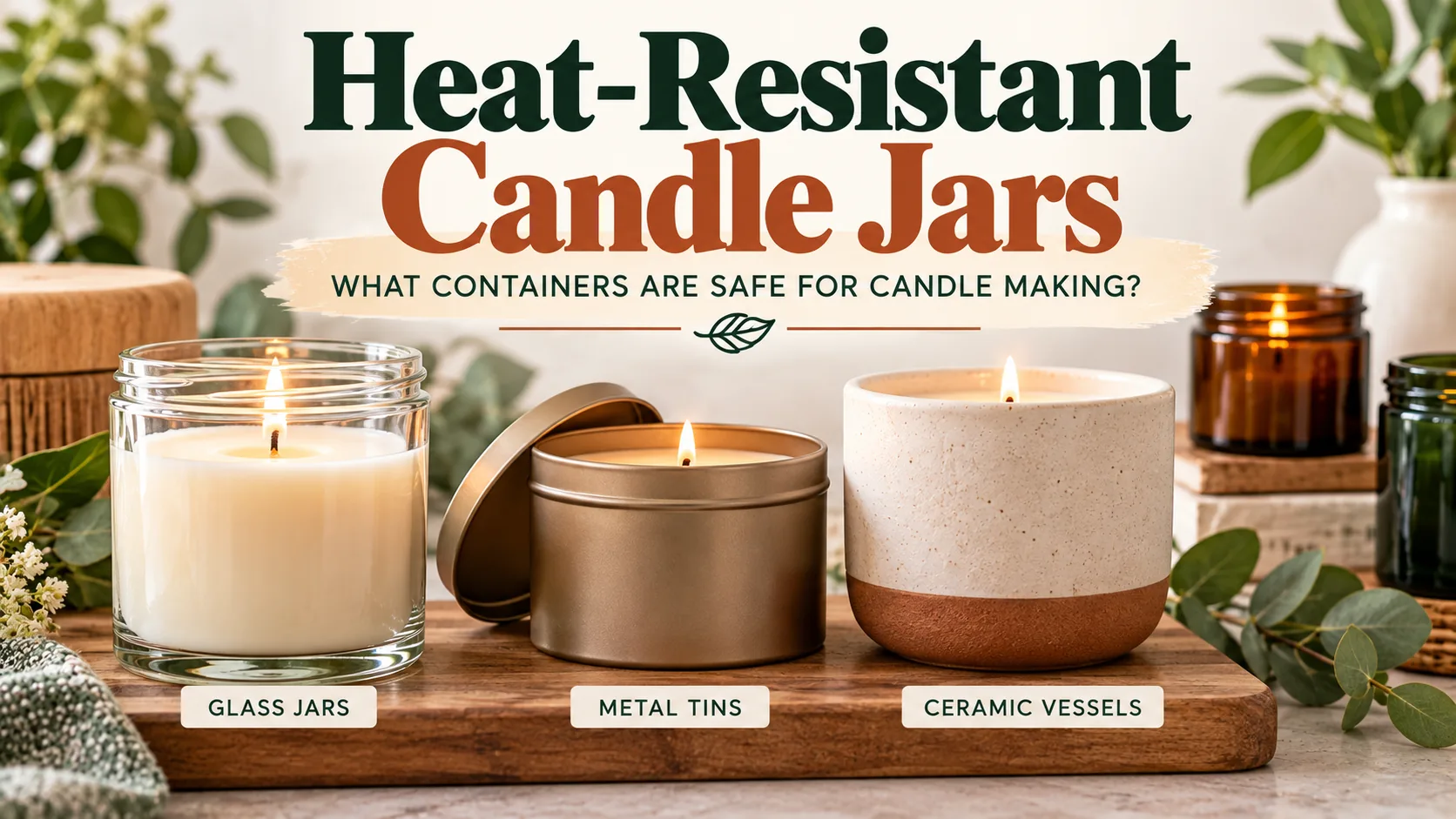
Choosing the right container is one of the most important decisions you’ll make when creating homemade candles. Although wax and fragrance often receive the most attention, the jar or vessel holding your candle plays a major role in how it burns.
Not every attractive glass jar is suitable for candle making. Some containers are specifically manufactured to tolerate the heat produced by a burning candle, while others may crack, overheat, or fail when exposed to repeated heating and cooling.
If you’re looking for heat-resistant candle jars, the key is understanding what makes a container suitable for candle use and how to verify that it is appropriate for your project.
In this guide, we’ll compare glass, ceramic, and metal candle vessels, explain whether Mason jars and recycled containers are suitable, and show you how to choose a container for your next candle-making project.
Quick Answer: What Jars Are Safe for Candle Making?
The best starting point is a new container specifically manufactured and documented for candle making. Common options include candle-rated glass jars, purpose-made metal candle tins, and ceramic vessels approved for candle use.
For glass candle containers, ask suppliers about compliance with ASTM F2179, the applicable glass candle-container specification.
Avoid random drinking glasses, damaged jars, plastic containers, and vessels with combustible decorations. Even purpose-made candle containers must be tested with the actual wax, wick, fragrance, and dye formula before use or sale.

What Makes a Candle Jar Heat-Resistant?
A candle container needs to withstand more than the initial temperature of melted wax. During burning, heat from the flame and molten wax travels into the vessel, potentially creating temperature differences between its walls, base, and rim.
A suitable candle container should be designed for its intended candle use and able to withstand those thermal conditions without unacceptable damage.
1. Appropriate Materials
The material must be suitable for exposure to the temperatures and operating conditions of a burning candle.
Purpose-made candle glass, selected metals, and properly manufactured ceramic vessels are commonly used.
2. Resistance to Thermal Stress
Thermal stress occurs when different parts of a material expand or contract at different rates due to temperature changes.
For glass containers, proper manufacturing and annealing help reduce residual stresses that can contribute to failure.
3. Structural Integrity
Cracks, chips, scratches, and manufacturing defects can reduce the reliability of a candle vessel.
Inspect every container before use, even if it comes from a reputable candle supplier.
4. Suitable Shape and Stability
The container should sit securely on a level surface and allow appropriate wick placement.
A straight-sided, wide-opening vessel is often easier for beginners to work with than a narrow-necked or irregularly shaped container.
5. Documented Candle Use
Most importantly, choose containers whose manufacturers identify them as suitable for candle making and provide supporting product information.
Being heat-resistant, microwave-safe, or dishwasher-safe for another purpose does not automatically make a glass container suitable for candle burning.
Understanding ASTM Standards for Candle Containers
In the United States, ASTM International publishes standards addressing candle safety and candle-container performance.
One especially relevant document is ASTM F2179-26, Standard Specification for Annealed Glass Containers That Are Produced for Use as Candle Containers.
The specification establishes requirements and test methods for certain annealed glass containers manufactured for candle use, including annealing and thermal-shock performance.
It does not mean that every glass item marketed as heat-resistant automatically complies.
When buying glass candle jars, ask suppliers:
- Is this container specifically manufactured for filled candles?
- Does the manufacturer document compliance with ASTM F2179?
- Are testing records or product specifications available?
- What are the recommended uses and limitations?
- Is the same vessel available consistently for repeat batches?
ASTM F2417 is another relevant standard addressing the fire safety of finished candles. The container is therefore only one part of a complete candle-safety evaluation.
For authoritative references, see ASTM F2179 and the U.S. Consumer Product Safety Commission’s candle standards overview.
Best Types of Heat-Resistant Candle Containers
Several container materials are commonly available from candle-making suppliers. Each offers different advantages for appearance, handling, and candle design.
1. Candle-Rated Glass Jars
Glass is one of the most popular materials for container candles because it allows candle makers to showcase the wax, color, and finished appearance.
Properly manufactured candle glass is available in clear, frosted, amber, and colored finishes.
Advantages:
- Wide range of sizes and designs
- Professional appearance
- Easy to coordinate with labels and packaging
- Available from specialized candle suppliers
- Suitable for many container-wax formulas when properly tested
Limitations: Glass can still crack or become dangerously hot if damaged or used with an unsuitable candle formula.
Best for: Soy candles, coconut-soy blends, paraffin container candles, and other formulations compatible with the selected vessel.
2. Metal Candle Tins
Metal candle tins are popular for small candles, travel products, and beginner candle-making projects.
They are typically lightweight, compact, and available with matching lids.
Advantages:
- Lightweight and easy to transport
- Often less vulnerable to breakage during shipping than glass
- Convenient for travel-sized products
- Available in multiple sizes and finishes
- Useful for testing smaller batches
Limitations: Metal conducts heat efficiently, so the sides and base can become very hot during burning.
Use tins manufactured for candles, test the complete formula, and never assume an ordinary food or storage tin is suitable.
3. Ceramic Candle Vessels
Ceramic candle containers can provide a decorative, premium appearance and are popular for handmade gift candles.
However, not every pottery item or ceramic mug is suitable for candle making.
Glaze quality, structural integrity, wall design, and thermal performance all matter.
Advantages:
- Decorative appearance
- Wide variety of finishes and styles
- Appealing for gift and boutique candle products
- Potential for matching product collections
Limitations: Some ceramic items can crack, overheat, or have glaze defects. Choose vessels specifically approved for candle use and test them with your formula.
Glass vs. Ceramic vs. Metal Candle Containers
| Material | Advantages | Considerations | Best Application |
|---|---|---|---|
| Candle-rated glass | Attractive, many styles, shows wax color | Breakage and thermal stress | Standard container candles |
| Candle-rated metal tins | Lightweight, compact, shatter-resistant | Can become very hot | Travel and small-batch candles |
| Candle-rated ceramic | Decorative and customizable | Glaze quality and thermal compatibility | Decorative and premium candles |
There is no universally safest material independent of its design and use. A properly documented glass vessel can be suitable, while an unsuitable metal or ceramic container can still present hazards.
Are Mason Jars Heat-Resistant Enough for Candles?
Mason jars are widely used in homemade candle projects because they are inexpensive, easy to find, and available in familiar shapes.
However, a jar designed for food preservation is not automatically certified or documented for use as a burning candle container.
Being suitable for a particular canning process does not establish performance under concentrated candle-flame heating or repeated candle burn cycles.
Before considering a Mason jar for candle making, verify whether the specific manufacturer approves that model for candle use.
If the manufacturer does not provide suitable documentation, choose a purpose-made candle jar instead.
Can You Use Regular Drinking Glasses for Candles?
Ordinary drinking glasses are not a recommended substitute for candle-rated containers.
A drinking glass may be strong enough for cold beverages or hot drinks without being designed for the prolonged and uneven heat exposure created by a candle.
Potential concerns include:
- Unknown thermal-shock performance
- Thin or uneven wall thickness
- Scratches from previous use
- Undocumented manufacturing specifications
- Shapes that concentrate heat or complicate wick selection
If you like the appearance of drinking-glass-style candles, look for candle-rated vessels with a similar shape.
Can You Reuse Old Candle Jars to Make New Candles?
Repurposing old containers is a creative way to reduce waste, but reusing an emptied candle jar for another burning candle requires caution.
Previous burning, cleaning, impacts, and repeated temperature changes may have affected the glass.
Even when a used jar looks undamaged, its manufacturer may not approve it for refilling.
For new burning candles, use a new, documented candle-rated vessel unless a manufacturer specifically supports reuse and the container meets the applicable requirements.
For non-burning projects, explore our eight creative ways to repurpose candle jars.
You can also find broader decorative inspiration in our DIY candle container upcycling guide.
What Containers Should You Avoid for Candle Making?
Some containers should not be used for burning candles unless the manufacturer has specifically designed and documented them for that purpose.
Thin or Unknown Glass
Avoid drinking glasses, decorative vases, and unidentified glass jars without candle-use documentation.
Cracked or Chipped Containers
Never use damaged glass or ceramic containers. Even small cracks can worsen under temperature changes.
Plastic Containers
Ordinary plastic storage containers are unsuitable for direct candle-flame exposure and may soften, deform, or ignite.
Narrow-Neck Bottles
Unusual shapes may create difficult wick and heating conditions. Avoid converting ordinary bottles into wicked candle vessels.
Containers With Flammable Decorations
Keep dried flowers, ribbons, twine, paper, and similar combustible materials away from flames and hot candle surfaces.
Unknown Handmade Pottery
Handmade ceramics should not be assumed safe simply because the material is fired clay. Seek documentation from the maker about the vessel’s intended use and thermal performance.
Does Candle Jar Thickness Determine Safety?
A common misconception is that thick glass is automatically suitable for candle making.
While wall design can influence performance, thickness alone does not establish thermal-shock resistance or suitability for candle burning.
Glass composition, annealing, residual stresses, scratches, and overall container geometry also matter.
Some candle-rated glass vessels may have relatively thin walls yet be manufactured and tested for their intended application.
Conversely, thick decorative glass can still fracture when exposed to unfavorable temperature differences.
The better rule: Choose a documented candle vessel rather than judging suitability by weight or thickness.
How Candle Jar Diameter Affects Wick Selection
The inside diameter of a candle jar influences how much wax the wick needs to melt during burning.
A wick that is too small may produce excessive tunneling, while an oversized wick can contribute to a tall flame, excessive soot, and overheating.
However, jar diameter is only one variable.
Wick selection also depends on:
- Wax formulation
- Fragrance type and concentration
- Candle dye concentration
- Wick material and construction
- Container geometry
- Manufacturer guidance
Start with the wick manufacturer’s recommended sizing range, then conduct controlled burn tests using the complete candle formula.
For an introduction to selecting compatible ingredients and equipment, read our basic materials needed to make homemade candles guide.
How to Check a Candle Jar Before Pouring Wax
Before every candle-making session, inspect your containers carefully.
Step 1: Verify the Intended Use
Confirm that the vessel was manufactured and documented for candle making. Keep the supplier’s specifications with your production records.
Step 2: Inspect the Glass or Vessel Surface
Look for cracks, chips, deep scratches, glaze defects, or damaged seams. Reject containers with visible defects.
Step 3: Check the Shape and Stability
Make sure the container sits flat and provides an appropriate opening and base for the selected candle design.
Step 4: Measure the Inside Diameter
Use the actual inside diameter at the relevant wax level when selecting initial wick sizes, rather than relying only on the jar’s advertised capacity.
Step 5: Review Wax Compatibility
Select wax intended for container candles. Different wax formulations can require different pouring temperatures, cooling conditions, and wick choices.
Step 6: Prepare Multiple Test Candles
Make identical samples with nearby wick sizes so you can evaluate the formula consistently.
How to Burn-Test Candle Containers
Even when a container comes from a reputable supplier, you should test the finished candle formula.
A complete candle system includes the vessel, wax, wick, fragrance, dye, and their interactions.
Changes to any of these variables can affect burning behavior and vessel temperature.
What to Observe During Testing
- Flame height and stability
- Sooting and smoking
- Wick mushrooming or debris
- Melt-pool behavior
- Container surface temperatures
- Changes to glass or ceramic surfaces
- Behavior near the end of the candle’s usable life
- Performance over repeated burn cycles
Follow applicable candle testing standards and supplier procedures. Use suitable measuring instruments and a controlled, supervised testing environment.
Testing one candle for a few minutes does not establish long-term safety. Nor does pouring hot water into a jar, heating it with a hair dryer, or placing it in an oven.
If a test candle displays hazardous behavior, stop the test safely and do not approve the formula for distribution.
How to Choose Candle Jars for a Small Candle Business
If you plan to sell handmade candles, container consistency becomes especially important.
The same vessel should be available in sufficient quantities, and its specifications should remain consistent between orders.
Look for suppliers that provide:
- Clearly identified candle-rated containers
- Relevant technical documentation
- Consistent dimensions and product specifications
- Replacement availability
- Reasonable shipping protection
- Wholesale or bulk purchasing options
- Clear manufacturer information
Don’t order hundreds of jars until you’ve completed testing with the exact container, wax, wick, and fragrance combination.
A container change can require renewed testing, even if the new jar looks similar to the previous one.
What Size Candle Jar Should Beginners Choose?
For beginners, I generally recommend selecting one simple straight-sided candle-rated jar from a supplier that publishes wick-selection guidance.
A moderate-sized container is often easier to work with than a very wide, narrow-necked, or unusually shaped vessel.
Focus on these purchasing criteria:
- Simple cylindrical shape
- Documented candle use
- Consistent inside diameter
- Suitable capacity for small test batches
- Compatible wick recommendations
- Availability of additional identical jars
Instead of buying many different jar sizes at first, choose one vessel and learn how the candle behaves.
Once your formula performs consistently, you can expand into additional vessel sizes and materials.
Matching the Right Wax to Your Candle Jar
Container candles need wax designed for use inside a vessel.
Some popular choices include soy container waxes, paraffin container blends, and coconut-soy blends.
These materials differ in melting characteristics, fragrance performance, appearance, and curing behavior.
Pillar wax, on the other hand, is generally designed to support its own shape after removal from a mold.
For a full explanation of different wax formulations, see how to choose the right type of wax for different candles.
Common Mistakes When Buying Heat-Resistant Candle Jars
Assuming All Glass Is Candle-Safe
Ordinary glassware and candle-rated glass are not interchangeable. Check the manufacturer’s documented intended use.
Choosing Containers Based Only on Appearance
A beautiful container may not be appropriate for repeated candle burning. Verify the technical information first.
Ignoring Internal Diameter
Jar diameter affects wick sizing and burn performance. Measure it accurately.
Reusing Damaged Containers
Cracked, chipped, or visibly damaged containers should not be used for burning candles.
Buying in Bulk Before Testing
Test small quantities first to avoid investing in containers that do not work with your planned formula.
Skipping Complete Burn Testing
Even a purpose-made vessel must be evaluated with the final candle formula.
Frequently Asked Questions About Heat-Resistant Candle Jars
What glass jars are safe for candle making?
Choose glass jars specifically manufactured and documented for candle making. For applicable annealed glass vessels, ASTM F2179 provides an important performance specification.
Can you use any heat-resistant jar for candles?
No. Heat resistance for cooking, canning, or hot beverages does not automatically establish suitability for a burning candle.
Are Mason jars safe for candle making?
Do not assume they are. Verify that the manufacturer approves the exact jar for candle use. Otherwise, choose a documented candle vessel.
Are ceramic containers safe for candles?
Purpose-made ceramic candle vessels can be suitable when manufactured, documented, and tested for the intended use. Ordinary mugs and decorative pottery should not automatically be considered candle-safe.
Are metal candle tins safe?
Metal tins manufactured for candle use are a common option, but they can become very hot during burning. Use an appropriate wick and fully test the finished candle.
Can candle jars crack from heat?
Yes. Glass can fail due to thermal stress, existing damage, defects, or unsuitable burning conditions. Documentation and testing help reduce risk but cannot eliminate every possibility of failure.
Does thick glass make a safer candle jar?
Not necessarily. Glass thickness alone does not prove that a container is appropriate for candle making. Glass composition, manufacturing quality, annealing, and container geometry also matter.
Can you use recycled glass jars for candles?
Ordinary recycled or repurposed jars should not be assumed suitable for refilling with a burning candle. They can still be useful for non-burning decorative projects.
Do candle jars need to be tested?
Yes. Select an appropriately documented container and then evaluate the complete candle system through suitable burn testing. Vessel documentation and finished-candle testing address different aspects of safety.
What is the best candle jar for beginners?
A new, straight-sided candle-rated glass jar with consistent dimensions and supplier wick recommendations is a practical starting choice.
Final Thoughts: Choose the Right Candle Container Before You Pour
Finding heat-resistant candle jars is about much more than choosing attractive or thick glass.
The most reliable approach is to purchase containers designed and documented for candle use, inspect them carefully, and perform complete testing with your selected wax and wick.
Glass jars, ceramic candle vessels, and metal tins can all be suitable options when used within their intended applications.
For beginners, starting with one simple candle-rated container makes it easier to develop a consistent formula and learn how changes in wax and wick selection affect performance.
A good candle starts with the entire system working together—and the container is a critical part of that system.
Leave a Reply