
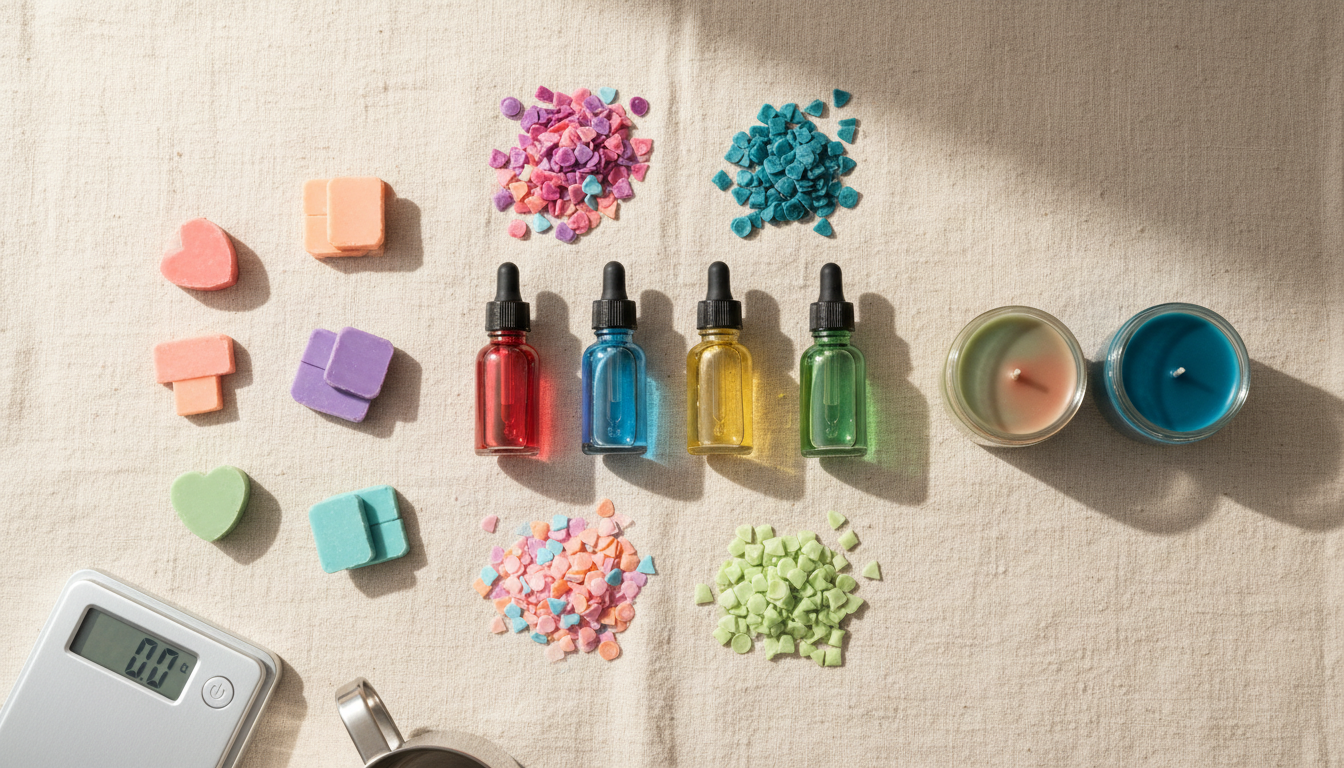
Candle dye is one of the cheapest supplies on your bench, but it has a big effect on how professional your candles look. A good dye dissolves completely, gives you the same color every time, and burns cleanly with the wick. A poor choice, or a kitchen substitute, can leave specks, fade unevenly or even clog the wick.
This guide compares the main types of candle dye, highlights three easy-to-find options for home candle makers, and explains how to choose the right format for your wax and batch size. You will also learn how to make your own dye chips, which is the safe version of “DIY candle dye.”
Quick answer: For most beginners, dye blocks are the easiest candle dye because each block colors a set amount of wax. If you want exact shades or soft pastels, choose liquid candle dye and add it drop by drop. Whatever you buy, make sure it is labeled for candles and for your type of wax.
Our Top Candle Dye Picks
These picks are chosen for their format, color range and fit for common home candle waxes. We have not run side-by-side lab tests on them, so treat this as a buying guide and always test a small batch in your own wax first.
| Candle dye | Format | Best for |
|---|---|---|
| Hearth & Harbor Candle Dye (24 colors) | Dye blocks | Beginners and repeatable batches |
| Hearth & Harbor Liquid Candle Dye | Liquid | Custom shades and pastels |
| YRYM HT Liquid Candle Dye | Liquid | A budget set with a wide color range |
As an Amazon Associate, Candle Creating earns from qualifying purchases.
1. Hearth & Harbor Candle Dye Blocks: Best for Beginners
Dye blocks take most of the guesswork out of coloring. Each block is sized to color a set amount of wax, so if you make the same candle every week, you can drop in the same number of blocks and get a matching color. A large color set also lets you blend your own shades by combining blocks.
- Why it stands out: pre-measured, easy to store, low mess, and simple to repeat.
- Keep in mind: making a half-shade means cutting a block, and very pale pastels are harder than with liquid dye.
- Check: the label for how much wax one block colors, and confirm it suits your wax type.
2. Hearth & Harbor Liquid Candle Dye: Best for Custom Colors
Liquid dye is concentrated, so a few drops go a long way. That makes it the most flexible format: you can nudge a color one drop at a time, mix two dyes to create a new shade, and make soft pastels that are hard to hit with blocks. It is a strong match for soy container candles, where many makers prefer lighter, muted tones.
- Why it stands out: fine shade control and easy color mixing.
- Keep in mind: it is easy to add too much. Count drops, and test a cooled drop of wax before pouring.
- Check: whether the set is labeled for soy and other natural waxes.
3. YRYM HT Liquid Candle Dye: Best Budget Set
If you want plenty of colors to experiment with before committing to a favorite brand, a budget liquid set is a sensible start. Use it the same way as any liquid dye: start with a drop or two per batch, stir fully, and test before you pour.
- Why it stands out: low cost per color and a wide palette for testing.
- Keep in mind: concentration can vary between brands, so do not reuse drop counts from another dye without testing.
Liquid vs. Blocks vs. Chips vs. Powder
All four formats are designed to dissolve in melted wax. The real difference is how easy they are to measure and how precisely you can control the shade.

| Format | Best for | Watch out for |
|---|---|---|
| Liquid dye | Exact shades, pastels, mixing colors | Very concentrated; count every drop |
| Dye blocks | Beginners and repeat batches | One block colors a fixed amount of wax |
| Dye chips | Small batches and testing many colors | Chip strength can vary; melt fully to avoid specks |
| Powder dye | Large production batches | Messy; must dissolve completely. Never use pigment powders |
How to Choose the Best Candle Dye
- Match the dye to your wax. Some dyes are formulated for paraffin and perform differently in soy, coconut or beeswax. Look for a dye labeled for natural or vegetable waxes if you pour soy. Our guide to types of candle wax explains how each wax affects color.
- Think about batch size. Blocks are perfect for one or two pounds at a time. Liquid is easier for tiny test pours. Powder makes sense only for large batches.
- Decide how much control you need. If you sell a signature color, choose a format you can measure the same way every time and write it down.
- Buy a color range you will use. A large set is great for experimenting, but most makers end up using a handful of colors. You can mix the rest.
- Only use dye made for candles. Candle dye is designed to dissolve in wax and burn with the wick. Cosmetic micas, pigments and food colors are not.
DIY Candle Dye: How to Make Your Own Dye Chips
Searching for “DIY candle dye” usually turns up crayons or food coloring, and neither works well (see below). The safe way to make your own dye is to turn a candle dye you already own into concentrated chips. This saves money, makes small batches easier, and helps you repeat custom colors.
- Melt a small amount of wax. Use one to two ounces of the same wax you pour candles with, weighed on a scale.
- Add concentrated dye. Stir in much more liquid dye, or more dye blocks, than you would use in a candle. Write down exactly how much.
- Pour into a silicone tray. An ice-cube or candy mold works well. Let the chips set completely.
- Label each batch. Note the color, the dye used, and how much wax each chip contains.
- Use and record. Add chips to a batch, test a cooled drop, and record how many chips per pound give your target shade.
Mixing custom colors works the same way. Make a chip for each base color and combine them until you hit the shade you want.
How Much Candle Dye Should You Use?
There is no single number because concentration varies by brand and format. Start with the dye maker’s guidance, then go lighter. Add dye gradually, test a cooled drop on white paper, and stop as soon as you hit the shade you want. Too much dye can affect how the candle burns, so more is not better.
Record the amount per pound of wax so you can repeat it. Our candle wax calculator helps you work out the wax weight for each batch, and our step-by-step guide on how to color candle wax walks through the full process for each dye format.
What Not to Use as Candle Dye
- Food coloring: it is water-based and will not mix with wax. It beads up, sinks and can make the candle sputter.
- Crayons: they are colored with pigment particles that don’t dissolve and can clog the wick.
- Mica powder: beautiful in wax melts, but it can clog the wick in a wicked candle.
- Spices and kitchen powders: turmeric, cocoa and coffee don’t dissolve. If you want a natural look, read our guide to natural candle dyes first.
Frequently Asked Questions
What is the best candle dye for soy wax?
A liquid dye or dye block labeled for soy or natural waxes. Soy is opaque and cools lighter than it looks when melted, so liquid dye is especially handy for building color gradually.
What is the best dye for beeswax candles?
Any candle dye made for natural waxes will work, but remember that yellow beeswax changes every color. Our guide on how to color beeswax candles shows how each dye color shifts.
Does candle dye affect how a candle burns?
Used as directed, very little. Heavy amounts of dye can change wick performance, so stick to the smallest amount that gives you the color you want and burn-test new formulas.
Can you mix candle dye colors?
Yes. Liquid dyes are the easiest to mix. With blocks, combine whole or cut pieces. Record your ratios so you can repeat the shade.
Why does my candle color look lighter after it cools?
Most candle waxes become more opaque as they set, which lightens and softens the color. Always judge a cooled drop on white paper, not the melted wax in your pitcher.
Leave a Reply