
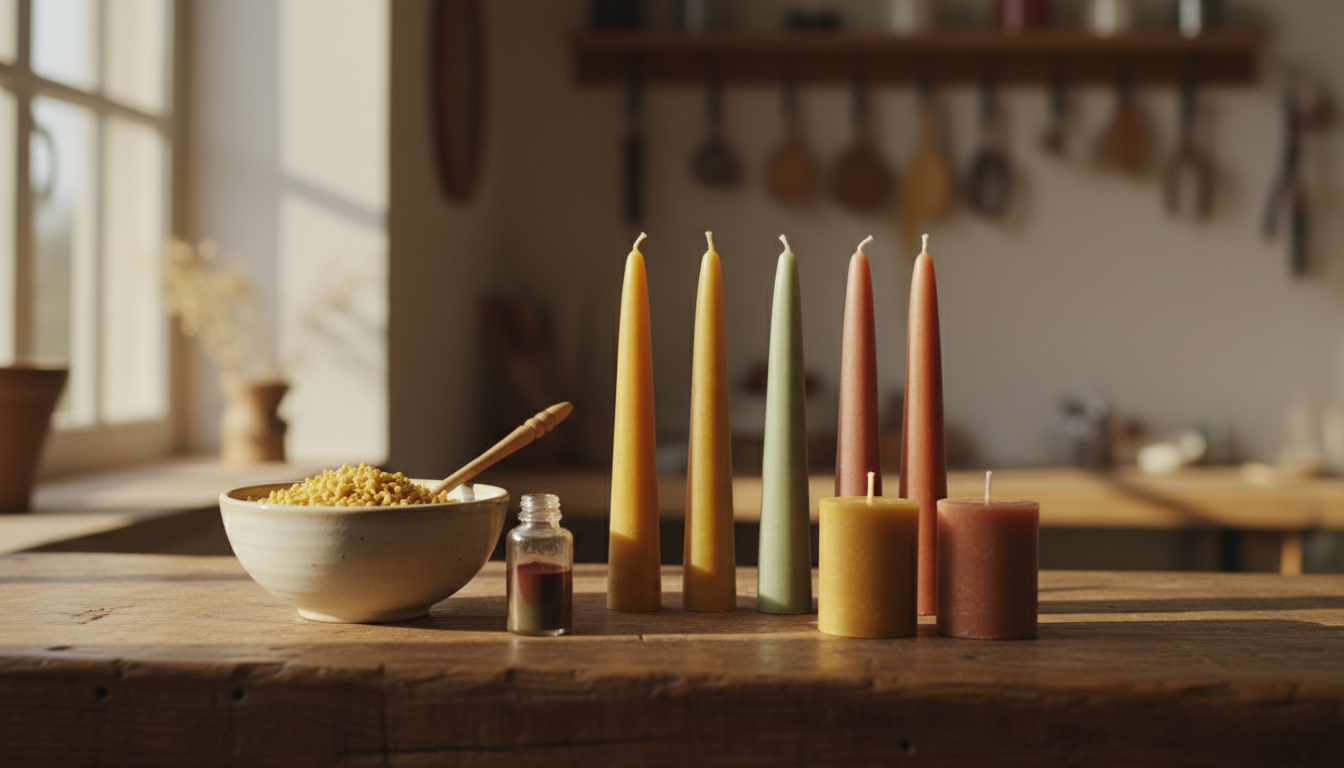
Beeswax makes some of the most beautiful candles you can pour: slow-burning, naturally golden, and lightly scented with honey. But if you have ever stirred blue dye into melted beeswax and watched it turn green, you already know that coloring beeswax works a little differently from coloring soy or paraffin.
This guide explains why that happens and walks you through three reliable ways to color beeswax candles: dyeing the whole batch, overdipping tapers, and working with natural colorants. You will also find a color chart, a troubleshooting table, and answers to the most common questions.
Quick answer: Yes, you can dye beeswax candles. Melt the beeswax, stir in a candle dye made for natural waxes, test a few drops on white paper, then pour or dip. Because natural beeswax is yellow, warm colors such as gold, orange, red, brown and olive turn out best. For true blues, pinks and purples, start with white (filtered) beeswax.
Can You Dye Beeswax Candles?
Yes. Beeswax accepts candle dye the same way other candle waxes do: the dye dissolves into the melted wax and stays suspended as it cools. The difference is the starting color. Most beeswax sold for candles is natural yellow, ranging from pale straw to deep honey gold depending on the hive and how it was filtered. That base color is part of every shade you make.
Beeswax is also denser and harder than container soy wax, and it is more opaque. That means colors read slightly softer and more muted than they would in paraffin. Neither of these is a problem once you plan for it.
Why Beeswax Changes Your Dye Colors
Think of natural beeswax as a jar of yellow paint. Anything you add mixes with that yellow. Blue plus yellow makes green. Red plus yellow leans orange. Purple, which sits opposite yellow on the color wheel, tends to turn brown or muddy.

Yellow beeswax vs. white beeswax
Yellow (natural) beeswax keeps its honey color and aroma. It is ideal for warm, earthy palettes and for candles you want to look as natural as possible.
White beeswax has been filtered or bleached to remove most of the color. It gives you a near-neutral base, so blues, pinks, lavenders and bright greens look much closer to the color in the dye bottle. It usually has less honey scent, which can be a plus if you plan to add fragrance.
If you want both, you can blend the two. A mix of white and yellow beeswax softens the gold without losing all of it.
What You Need
- Beeswax in pellet or block form, such as Beesworks yellow beeswax pellets or VIPwax yellow beeswax. Use white beeswax for cool colors.
- Candle dye in liquid, block or chip form, such as Hearth & Harbor liquid candle dye or Hearth & Harbor dye blocks.
- A double boiler or temperature-controlled wax melter
- A candle thermometer and a digital scale
- A metal pouring pitcher and a heat-safe stirring utensil
- Wicks sized for beeswax (beeswax usually needs a larger wick than soy or paraffin)
- Molds, containers, or a tall dipping vat for tapers
- White paper or a white plate for color tests
As an Amazon Associate, Candle Creating earns from qualifying purchases.
Method 1: Dye the Whole Batch
This is the simplest method and works for pillars, molded candles, votives, container candles and dipped tapers.
- Weigh the beeswax. Write down the weight. Dye amounts are based on it, and recording it lets you repeat a color later.
- Melt gently. Melt the beeswax in a double boiler or melter. Beeswax melts at roughly 144–147°F. Follow your supplier’s heating and pouring temperatures, and avoid overheating, which can darken beeswax and dull your colors.
- Add dye a little at a time. Start with less than you think you need: a drop or two of liquid dye, or a small shaving of a dye block. Stir gently for one to two minutes so the dye fully dissolves.
- Test the color. Drip a little wax onto white paper and let it cool. Cooled beeswax always looks lighter and more opaque than the liquid in your pitcher, so judge the cooled drop, not the pot.
- Adjust and record. Add more dye if needed, testing after each addition. Write down the total amount so you can match the color next time.
- Add fragrance if using. Add it at the temperature your wax and fragrance suppliers recommend, and stay within the fragrance load for beeswax.
- Pour or dip. Pour at the supplier’s recommended temperature, or begin dipping tapers. Let candles cool slowly away from drafts.
Method 2: Overdip Beeswax Tapers
Overdipping gives you a colored shell over a natural beeswax core. It uses far less dye and lets you make several colors from one batch of natural tapers. It is also how many traditional taper makers get rich, saturated colors on beeswax.
- Make or buy natural tapers. Dip or mold plain beeswax tapers first and let them cool completely. Our guide to taper candle molds covers the molded route.
- Prepare a dye vat. Melt a separate batch of beeswax in a tall, narrow container deep enough to cover the taper. White beeswax gives the truest overdip colors. Add dye until a test drop is a shade darker than your target.
- Dip in short passes. Hold the taper by its wick, dip it smoothly into the colored wax, and lift it straight out. Let it cool for 30 seconds or so between dips.
- Build the color. Three to five dips usually give an even, opaque shell. More dips give deeper color and a slightly thicker taper.
- Finish and trim. Hang the tapers to cool fully, then trim the bases flat with a warm knife so they sit straight in holders.
Overdipped tapers drip in the color of the inner wax as they burn, which most people find attractive. If you want drip-resistant tapers, the wick and wax matter more than the color coat.
Method 3: Natural Colorants for Beeswax
Many people choose beeswax because it is natural, so it makes sense to want a natural dye too. Here is the honest picture.
- The wax’s own color is the best natural dye. Unfiltered beeswax can be deep gold, and blending yellow with white beeswax gives you a range of natural creams and honey tones with no additive at all.
- Filtered botanical infusions can work, with care. Annatto seed can tint beeswax a warm yellow-orange, and alkanet root gives muted mauve tones that often read brownish against yellow wax. Infuse the dry botanical in melted wax at low heat, then strain out every visible particle.
- Powders, spices and kitchen ingredients usually fail. Turmeric, cocoa, coffee, beet powder and spirulina don’t dissolve. Particles settle around the wick and can weaken or drown the flame.
Botanical color is an experiment, not a recipe, and every botanical batch needs a full burn test. Our detailed guide to natural candle dyes explains the filtered-infusion method step by step, including which ingredients to avoid.
What About Rolled Beeswax Candles?
Rolled candles are made from honeycomb-textured beeswax sheets instead of melted wax. The easiest way to get color is to buy sheets that are already dyed. Kits like the beeswax candle rolling kit and our beeswax candle kit for kids include a range of colors, and you can layer two colors in one candle for stripes or spirals. Melting and re-dyeing thin sheets at home is difficult and not worth the effort for most makers.
Best Colors for Natural Beeswax
| Color family | On yellow beeswax | Tip |
|---|---|---|
| Gold, amber, orange | Excellent | Works with the wax’s natural color |
| Red, burgundy | Very good | Expect a warmer, slightly orange red |
| Brown, chocolate | Very good | Deep and natural-looking |
| Olive, forest green | Good | Green dye deepens toward olive |
| Blue, teal | Turns green | Use white beeswax for true blue |
| Pink, lavender, purple | Poor | Use white beeswax; purple goes brown on yellow |
| Black | Fair | Takes a lot of dye; deep charcoal is more realistic |
Don’t Forget the Wick
Beeswax is dense and burns hotter and slower than most container waxes, so it generally needs a larger wick. Dye adds one more variable. Small amounts of candle dye rarely cause problems, but heavily dyed candles, and any candle with botanical material, should be burn-tested before you gift or sell them. See our guide to candle wick types to choose a starting size.
Troubleshooting Colored Beeswax
| Problem | Likely cause | Fix |
|---|---|---|
| Color is too pale | Not enough dye, or you judged the liquid instead of the cooled wax | Add dye gradually and always test a cooled drop |
| Color looks muddy or brown | Cool dye colors mixing with yellow wax | Switch to white beeswax or choose a warmer color |
| Specks or streaks | Dye chips not fully dissolved | Stir longer at full melt; use liquid dye for small batches |
| Uneven overdip coat | Dipping too fast or the dye vat too cool | Dip in smooth single passes and keep the vat at a steady temperature |
| White, dusty film on the surface | Natural beeswax “bloom” | Harmless; buff with a soft cloth or warm briefly with a hair dryer |
| Weak flame after dyeing | Too much dye, or undissolved particles at the wick | Reduce the dye, remove botanicals, then retest the wick size |
Frequently Asked Questions
Can you use food coloring to dye beeswax?
No. Most food coloring is water-based, and water does not mix with wax. It beads up, sinks or leaves specks, and trapped moisture can make the candle sputter. Use a candle dye instead.
Can I color beeswax with crayons?
It is not recommended. Crayons are colored with pigment particles rather than wax-soluble dye. The particles don’t dissolve and can clog the wick, giving a small, sooty or failing flame.
Can I use mica powder in beeswax candles?
Not in wicked candles. Mica does not dissolve and can clog the wick. It is fine for beeswax wax melts or for brushing onto the outside of a finished decorative candle, away from the wick.
How much dye do I need for beeswax?
It depends on the dye’s concentration and how deep a color you want, so follow the dye maker’s guidance and start low. Beeswax is opaque, so deep colors take more dye than they would in paraffin. Add dye gradually, test a cooled drop each time, and record the amount per pound of wax.
Will dye change the honey scent of beeswax?
Candle dye is used in small amounts and normally has little or no effect on scent. If you want less honey aroma, white beeswax is the better route.
Does coloring beeswax make it less natural?
Most candle dyes are synthetic, so a dyed candle is no longer 100% natural. If an all-natural label matters to you, use the beeswax’s own color or a carefully filtered botanical infusion, and describe the ingredients accurately.
Leave a Reply