
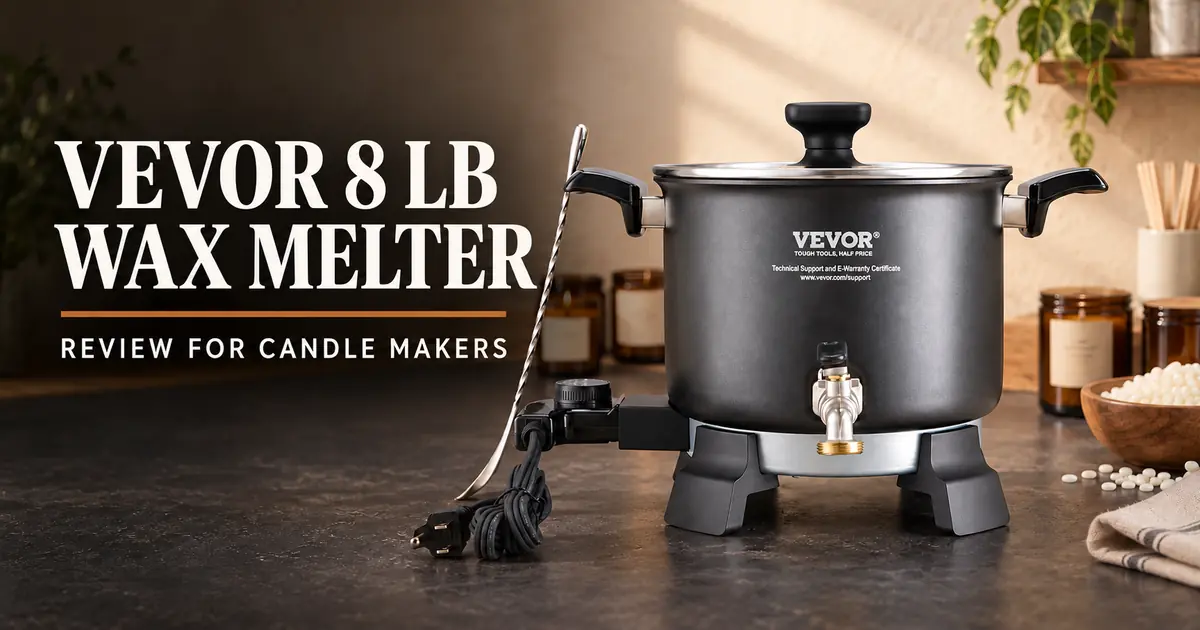
Equipment review for candle makers
Move beyond the double boiler—without outgrowing your workbench.
The VEVOR 5L electric wax melter combines a 1,200W heating system, four temperature levels and a bottom dispensing spout. It can streamline repeated pours, but its “8 lb” name deserves a closer look.
Check availability on AmazonThe short answer
A useful bridge between kitchen-scale batches and true production equipment.
The fast heater and dispensing valve can remove repetitive lifting and pouring from a small candle workflow.
The VEVOR 8 lb wax melter is best suited to serious hobbyists and small-batch makers who regularly melt several pounds of one wax at a time. Its 5-liter vessel, 1,200W heater and spout can make repeat pours more efficient than transferring hot wax from a double boiler.
It is not a precision, set-and-forget production tank. The listing describes four temperature levels over a 70–150°C (158–302°F) range, not fine degree-by-degree control. The title says “8 lb,” while the listing itself states a 7.5-pound wax capacity and a lower 4.3-liter standard fill line. Plan batches below the maximum, verify actual wax temperature with a separate thermometer and expect some wax to remain around the valve and vessel walls.
What the listing says
VEVOR 8 lb wax melter specifications
This review covers Amazon ASIN B0CNP46VCW, model DT-S005(B). Product variants can look similar but have different capacities, power requirements and controls, so confirm the exact model before ordering.
| Advertised product name | VEVOR 8Lbs Wax Melter for Candle Making |
|---|---|
| Model | DT-S005(B) |
| Vessel capacity | 5 liters / 305 cubic inches |
| Standard fill line | 4.3 liters / 262 cubic inches |
| Wax claim | Up to 7.5 pounds of candle wax per batch, according to the listing |
| Power | 1,200 watts |
| Voltage | 120 volts |
| Temperature range | Four adjustment levels spanning 70–150°C / 158–302°F |
| Listed wax types | Soy, beeswax and paraffin |
| Product size | 14.76 × 11.61 × 10.04 inches |
| Net weight | 5.95 pounds / 2.7 kilograms |
| Included accessories | Stainless steel mixing spoon, two wick holders, 100 cotton wicks, 100 wick stickers and one plastic spatula |
The useful feature is the workflow—not just the capacity
A melter earns its bench space when it lets you heat a larger base batch, dispense a measured amount into a separate pouring pitcher, add fragrance and color there, and repeat. This keeps multiple scents out of the main tank and reduces cleanup between variations.
Read the label carefully
Is it really an 8-pound wax melter?
The product title rounds the machine to “8 lbs,” but the detailed listing says the 5-liter pot can melt 7.5 pounds of wax and identifies a standard fill line of 4.3 liters. Those are not contradictory measurements—liters describe volume, pounds describe mass—but they do show why “8 lb” should not be treated as a guaranteed pourable yield.
Different waxes have different bulk densities, especially before melting. Flakes, pastilles and beads pack differently. Once melted, the practical amount is also limited by safe headspace, stirring room, expansion, the spout position and the residue left behind.
Do not fill to the rim
Leave room for loading, stirring and safe movement. Follow the fill line and the current manual rather than trying to force a full eight pounds into the tank. A spill of hot wax around a 1,200W appliance is a preventable burn and electrical hazard.
Batch planning
How many candles can one batch make?
Using the listing’s 7.5-pound claim gives a theoretical 120 ounces of melted wax. Your usable output will be lower after leaving headspace, retaining wax around the spout and accounting for transfer loss. Fragrance also contributes to the finished candle’s net fill, so do not simply divide wax weight by the jar’s advertised fluid-ounce capacity.
| 6 oz finished fill | Up to 20 candles from 120 oz of material in perfect conditions; plan fewer in practice |
|---|---|
| 8 oz finished fill | Up to 15 candles in perfect conditions; real output will be lower |
| 10 oz finished fill | Up to 12 candles in perfect conditions; allow for headspace and process loss |
| 12 oz finished fill | Up to 10 candles in perfect conditions; weigh every finished pour |
For a dependable production plan, weigh the water capacity of one container, convert it to an estimated wax fill using the method in our candle wax calculator, include your chosen fragrance load, then add a small process allowance. Run one verified batch before promising a specific unit count.
Heat management
What to expect from four temperature levels
The listing describes a four-level control covering 70–150°C (158–302°F), with Fahrenheit and Celsius markings and an indicator that signals when the unit enters its temperature-holding state. That is convenient for melting, but it is broader and less precise than a digital controller that lets you choose any exact degree.
VEVOR claims the 1,200W system can melt 1 kilogram of soy wax in about 10 minutes. Treat that as a best-case manufacturer claim, not a promise. Starting temperature, room conditions, wax form, batch depth and lid use will change the result.
Use the dial for melting
Select a setting appropriate to the wax maker’s instructions and reduce heat as the last solids disappear. Do not assume the dial represents the exact temperature throughout the whole batch.
Use a thermometer for decisions
Stir carefully and check the center and lower portion of the wax with a separate candle thermometer before adding anything or transferring to a pitcher.
Melting temperature, fragrance-add temperature and pour temperature are three different decisions. Follow the instructions for your exact wax rather than using one dial position for every formula. If you are comparing materials, see our guide to choosing the right candle wax.
A cleaner production method
How to use the VEVOR wax melter for candles
Read the supplied manual first. The sequence below is a general candle-production workflow and does not replace the manufacturer’s operating and safety instructions.
Inspect and position the machine
Confirm that the cord, plug, vessel, lid and valve are undamaged. Place the melter on a dry, stable, heat-resistant surface with clear space around the body and spout.
Close the valve before loading
Check the spout position before adding wax. Load clean wax gradually and stay at or below the marked working line.
Select a suitable heat level
Use your wax supplier’s melting guidance. Fit the lid if the manual allows it, monitor the appliance continuously and stir carefully as the wax softens.
Verify the actual wax temperature
Use a separate thermometer after stirring. Reduce the setting before the wax overshoots the range required by your formula.
Dispense by weight
Place a heat-safe pouring pitcher on a scale, tare it and dispense the needed wax through the spout. Close the valve fully before moving the pitcher.
Add fragrance and color in the pitcher
For multiple scents, keep the main melter filled only with unfragranced, undyed wax. Weigh additions separately and mix according to supplier directions.
Pour, document and repeat
Record temperatures and weights, fill prepared vessels, then repeat while the remaining base wax stays within the intended working range.
The feature that changes the workflow
What the bottom spout does well—and where it can struggle
A bottom valve reduces the need to lift and tip a pot of hot wax. It also lets a maker dispense into a pitcher on a scale, which is often more controllable than filling candle jars directly from the tank.
Why the spout helps
- Less lifting and tipping of a hot vessel.
- Fast repeat portions for multiple pitchers.
- Base wax can remain neutral while pitchers receive different scents.
- Weight-based dispensing supports consistent batch records.
What to watch
- Wax in the valve can cool faster than wax in the tank.
- Very small pours can overshoot if the valve is opened too far.
- Residue can remain below or around the outlet.
- Color and fragrance in the tank make changeovers harder.
Do not force a valve that has solidified wax in it. Follow the manual’s reheating and cleaning method. Place the receiving pitcher close enough to avoid splashing, open the valve gradually and keep hands away from the hot stream.
Compare the exact model before ordering
Confirm that the live listing still shows the 5L, 120V, 1,200W DT-S005(B) variant and review the current included accessories.
See current Amazon details As an Amazon Associate, Candle Creating may earn from qualifying purchases.Protect the next batch
Cleaning the tank and changing waxes
The simplest cleaning strategy is prevention: use the main tank for one uncolored base wax and blend fragrance and dye in separate pouring pitchers. That limits scent carryover and avoids staining the valve with strong dye.
- Dispense as much usable wax as possible while it is still safely fluid.
- Switch off and unplug the appliance before detailed cleaning.
- Follow the manual’s cooldown instructions; never immerse the electrical body.
- Wipe residual wax with disposable, heat-safe material while the surface is warm enough for the wax to release but safe to handle.
- Clear the valve only by the manufacturer’s approved method—never push a sharp tool into it.
- Keep water and household cleaners out of wax intended for candles.
One wax per melter is the efficient approach
If you regularly use soy, paraffin and beeswax, frequent full changeovers may erase the time saved by the melter. Dedicate the tank to your highest-volume wax when possible and use a smaller double boiler or pitcher for occasional formulas.
Buying decision
Pros, limitations and who should consider it
Potential advantages
- 1,200W heater is designed for faster melting than a low-power warming pot.
- 5L size fits a serious hobby or small production bench.
- Bottom spout supports repeatable, scale-based dispensing.
- Four heat levels are simple to operate.
- Listing identifies soy, beeswax and paraffin compatibility.
- Wicks, stickers, holders and mixing tools are bundled for beginners.
Important limitations
- “8 lb” product name overstates the listing’s 7.5-pound batch claim.
- Four levels offer less precision than a true digital controller.
- Actual wax temperature still needs independent verification.
- Spout and valve require careful cleaning and can retain wax.
- Full batches are heavy, hot and inappropriate for unattended use.
- Included wicks are not automatically correct for your vessels and wax.
This melter makes sense if you…
- Regularly make more candles than a small pouring pitcher can handle.
- Want to dispense neutral melted wax into separate scented pitchers.
- Have a stable, dedicated, heat-safe workspace and a suitable 120V outlet.
- Already understand temperature control, fragrance math and burn testing.
Stay with a double boiler or smaller melter if you…
- Make only one or two candles at a time.
- Change wax type, dye or fragrance in nearly every batch.
- Need exact digital temperature control built into the unit.
- Do not have room to operate and store the appliance safely.
A high-power hot-wax appliance
Electrical and candle-making safety
This is not a slow cooker to leave in the background. The listing specifies 1,200W at 120V—approximately 10 amps at full rated power—so the condition of the outlet, cord and circuit matters. Follow the manual and local electrical requirements, and never use an improvised power arrangement.
Essential precautions
- Never leave melting wax or the powered appliance unattended.
- Use a dry, level, heat-resistant surface away from children, pets and foot traffic.
- Keep water away from hot wax and all electrical components.
- Do not exceed the marked fill line or move the unit while it contains hot wax.
- Wear suitable eye protection, closed shoes and heat-resistant gloves.
- Verify wax temperature with a separate thermometer and avoid overheating.
- Use a current-rated wall outlet and follow the manual regarding extension cords or power strips.
- Keep a metal lid nearby to cover a small wax fire; never throw water on burning wax.
- Unplug before cleaning, inspecting or storing the melter.
The bundled wicks and stickers are supplies, not a validated candle system. Every wax, fragrance, dye, vessel and wick combination needs controlled burn testing before candles are sold or gifted. Our guide to common candle-making mistakes explains why scaling a formula does not remove the need for testing.
Plan the complete workflow
Choose the wax, calculate the batch and prepare your bench
Frequently asked questions
VEVOR 8 lb wax melter questions
How much wax does the VEVOR 8 lb melter hold?
The detailed listing specifies a 5-liter vessel, a 4.3-liter standard fill line and a claimed maximum of 7.5 pounds of wax. “8 lb” is the rounded product name. Use the marked working line and leave safe headspace.
How many 8-ounce candles can one batch make?
Dividing the listing’s 120-ounce wax claim by an 8-ounce finished fill gives a theoretical maximum of 15. Actual output will be lower because of headspace, residue, transfer loss and the fact that fragrance contributes to the finished fill weight.
Can the VEVOR melter handle soy wax?
Yes. The listing identifies soy, beeswax and paraffin as compatible wax types. Follow the temperature guidance for your exact wax and confirm actual wax temperature with a separate thermometer.
Can it melt beeswax?
VEVOR lists beeswax among the supported waxes. Beeswax generally needs more heat than many container soy waxes and can be harder to clean, so use the wax supplier’s guidance and consider whether you want to dedicate the vessel to that material.
Does it have digital temperature control?
No. This model is described as having four temperature levels spanning 70–150°C (158–302°F), with Fahrenheit and Celsius markings. Use an independent thermometer when temperature accuracy matters.
Should fragrance oil go directly into the melter?
It can make cleanup and changeovers harder. A more flexible workflow is to keep neutral wax in the tank, dispense a weighed amount into a pouring pitcher and add fragrance there according to the wax and fragrance suppliers’ instructions.
Can I pour straight from the spout into candle jars?
You can dispense through the spout, but a pitcher on a scale gives better weight control and lets you mix fragrance evenly before filling jars. It also reduces the risk of overfilling multiple vessels.
Why does wax stop flowing through a melter spout?
The wax in or near the valve can cool and solidify sooner than the main batch. Do not force the valve or insert sharp tools. Follow the manual’s approved reheating and clearing procedure.
Is a 1,200W wax melter suitable for a standard outlet?
The model is listed for 120V and draws about 10 amps at its rated 1,200W power. Use a sound, appropriately rated wall outlet and follow the manual and local electrical requirements. Avoid sharing the circuit with other high-power appliances.
Is it large enough for a candle business?
It can suit a side business or micro-batch workflow, particularly when one base wax is dispensed into several pitchers. A growing business may eventually need multiple tanks, tighter digital control or larger commercial equipment.
Leave a Reply