
Candle care product review
A better burn begins before you light the wick.
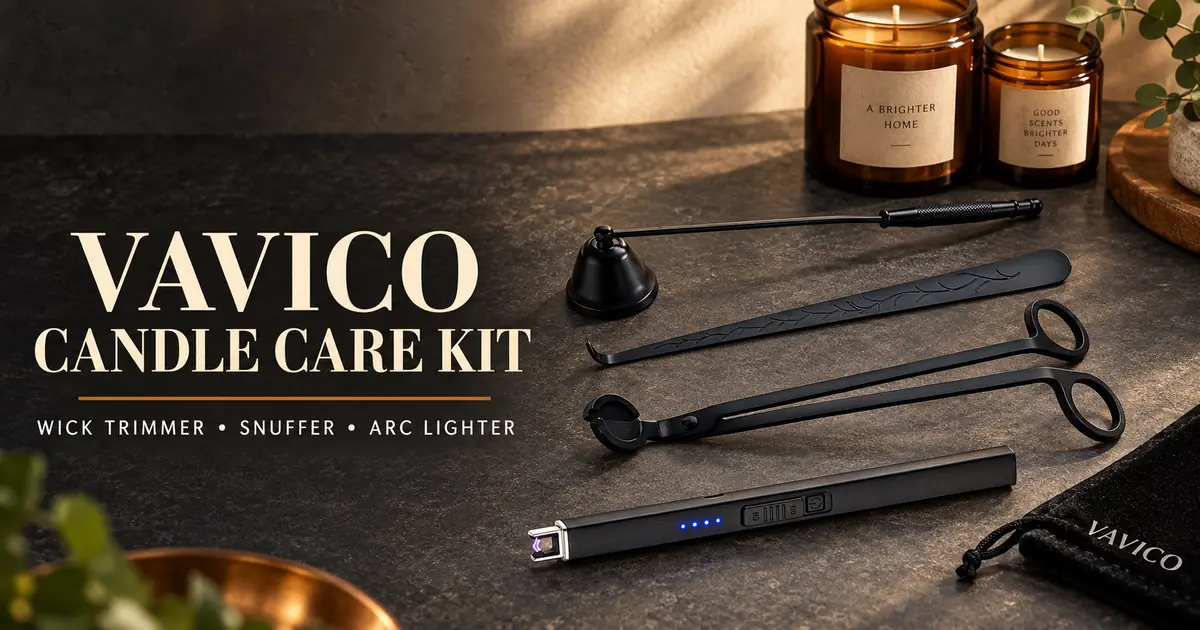
The matte-black VAVICO set combines four everyday candle tools: a wick trimmer, bell snuffer, wick dipper and rechargeable arc lighter. The value is convenience—but each tool has a different job.
Check availability on AmazonThe short answer
A practical all-in-one kit for people who burn candles often.
The wick trimmer is the everyday essential; the snuffer, dipper and lighter add convenience and choice.
The VAVICO candle care kit is a sensible starter set for jar-candle owners who want coordinated tools instead of buying each piece separately. The long-handled trimmer helps shorten a cooled wick, the bell snuffer shields the flame while extinguishing it, the dipper offers a low-smoke extinguishing method, and the rechargeable arc lighter reaches into deeper vessels.
The set will not correct an incorrectly wicked candle, eliminate every trace of smoke or make unsafe burning practices acceptable. The lighter still creates a high-temperature electric arc, and the dipper should only touch a wick briefly—never leave wick debris in the melt pool.
Five pieces in the package
What comes in the VAVICO candle care kit?
The matte-black variant is listed as a coordinated set containing four tools and one charging cable. The tools address different stages of candle use rather than duplicating the same function.
| Wick trimmer | Long-handled angled cutter intended to shorten cooled candle wicks to approximately 1/4 inch. |
|---|---|
| Bell snuffer | Long-handled bell placed over the flame to deprive it of oxygen without blowing across liquid wax. |
| Wick dipper | Hooked tool used to bend a lit wick briefly into the melt pool and lift it upright again. |
| Arc lighter | USB-rechargeable, flameless electric lighter with a two-step ignition and four-LED battery display. |
| Charging cable | USB cable for recharging the included lighter; wall-adapter details should be checked on the current listing. |
| Reviewed color | Matte Black, Amazon ASIN B0967CBKR3. Gold and rose-gold variants are also listed. |
Why the four-tool format makes sense
A trimmer prepares the wick, a lighter starts the burn, and the snuffer or dipper ends it. You do not need to use both extinguishing tools every time, but the choice lets you match the method to the candle and your comfort level.
The tool you will use most
How the VAVICO wick trimmer fits regular candle care
A wick trimmer reaches down into a candle jar and cuts horizontally where ordinary scissors become awkward. The angled handle keeps your fingers above the vessel, while the small platform behind the blades can catch the trimmed wick before it falls into the wax.
The product listing recommends maintaining a 1/4-inch wick. That is a common starting point for many container candles, but the candle maker’s label takes priority. Wooden wicks and some specialty wick systems may require a different length.
How to trim a candle wick cleanly
- Wait until the candle is completely cool and the wax is firm.
- Remove loose soot or debris from the candle surface.
- Hold the trimmer level and position the blades above the wax.
- Cut the charred tip without gouging the wax or cutting the wick excessively short.
- Lift the trimmer slowly so the clipped material stays on its catching plate.
- Discard the clipping before lighting the candle.
Trimming improves conditions; it does not redesign the candle
A properly maintained wick can reduce oversized flames, soot and mushrooming, but persistent problems may come from the wick size, fragrance load, vessel or formula. Stop using a candle that burns unpredictably or overheats its container.
Flameless does not mean heatless
The rechargeable arc lighter: convenient for deep jars
The included lighter uses an electric plasma arc rather than a butane flame. According to the listing, ignition requires two actions: slide the safety control forward and then press the ignition switch. Four LEDs display the approximate charge level, with all four illuminated when fully charged.
The long neck can reach a wick that sits below a jar rim, and an electric arc is less affected by moving air than a conventional flame. It also avoids buying disposable butane utility lighters. The tradeoff is charging, electronics and the need to keep the arc away from skin, wax, metal tools and flammable fragrance spills.
Where it helps
- Lighting wicks inside taller candle jars.
- Avoiding repeated purchases of disposable lighters.
- Checking charge status through the LED indicator.
- Using a two-step control that reduces accidental activation.
What to consider
- The arc can burn skin and ignite combustible material.
- The battery must be charged and stored correctly.
- Wax buildup near the electrodes can reduce performance.
- Do not operate it while charging unless the instructions explicitly permit it.
Keep the arc at the wick—not in the wax
Touch the arc to the exposed wick only long enough for ignition. Do not press the lighter into liquid or softened wax. Allow the lighter to cool, switch it off and keep it away from children and pets.
Two ways to end a burn
Candle snuffer versus wick dipper
Both tools extinguish a candle without blowing across the melt pool, but they work differently. Neither is universally better. The best choice depends on the vessel, wick, wax depth and the user’s ability to handle a tool near hot wax.
| Bell snuffer | Lower the bell over the flame without touching the wick or wax. Hold it in place until the flame is out, then lift vertically. It is intuitive and keeps faces away from smoke. |
|---|---|
| Wick dipper | Use the hook to bend the lit wick into the liquid melt pool for a moment, then lift and recenter it immediately. This can limit the smoke plume and coat the wick with wax for the next lighting. |
| Best beginner choice | The snuffer is generally simpler because it avoids deliberately moving the wick through hot wax. |
| Best low-smoke option | The dipper can work well when used correctly, but it requires more control and should not be used if the melt pool is shallow or difficult to reach safely. |
After dipping, return the wick upright and reasonably centered before the wax hardens. A bent or buried wick can be hard to relight and may create an uneven burn. Never use the dipper to fish around in hot wax while the candle remains lit.
Use the tools in sequence
A safer candle-care routine from first light to extinguishing
Inspect the candle
Check the vessel for cracks, confirm the wax is free of debris and place the candle on a stable, heat-resistant surface away from drafts and combustibles.
Trim the cooled wick
Follow the candle label. For many cotton wicks, approximately 1/4 inch is a common target. Remove every clipping from the wax.
Light with the arc centered on the wick
Activate the lighter only when it is positioned safely. Apply the arc briefly, release the switch and move the lighter away once the wick catches.
Monitor the entire burn
Never leave the candle unattended. Keep the flame away from children, pets, curtains, shelves and air movement. Follow the maker’s maximum burn-time instruction.
Extinguish without splashing wax
Use the snuffer or carefully dip and immediately straighten the wick. Do not blow forcefully across a full melt pool.
Let everything cool
Do not trim, move, cap or store the candle until the wax and vessel have cooled. Wipe tools only after they are safe to handle.
Want to compare the current set?
Confirm the matte-black color, included pieces, seller and current availability on the live Amazon listing.
See current Amazon details As an Amazon Associate, Candle Creating may earn from qualifying purchases.Buying decision
Pros, limitations and who should consider it
Potential advantages
- Four complementary candle tools in one coordinated finish.
- Long-handled trimmer reaches inside common jar candles.
- Rechargeable lighter reduces dependence on disposable butane lighters.
- Two-step lighter control and battery-level LEDs add convenience.
- Snuffer and dipper provide two extinguishing methods.
- Presentation makes the set suitable as a candle-lover gift.
Important limitations
- Some users may rarely need both a snuffer and dipper.
- The electric lighter adds a battery and charging cable to maintain.
- Matte-black tools can show wax, soot and fingerprints.
- Wick trimmers still require careful alignment in narrow vessels.
- A generic 1/4-inch trim is not correct for every candle.
- No accessory can make a poorly designed or damaged candle safe.
The kit is a strong fit if you…
- Burn jar candles frequently and want a consistent care routine.
- Have deeper vessels that are awkward to light with a match.
- Prefer a coordinated matte-black tool set.
- Want a gift that feels more complete than a wick trimmer alone.
Consider buying only a trimmer if you…
- Already own a reliable utility lighter and snuffer.
- Burn candles infrequently or use mostly shallow tins.
- Do not want another rechargeable device to store and maintain.
- Prefer the simplest possible candle-care setup.
Keep soot and wax under control
Cleaning and storing the candle tools
Let every tool cool before cleaning. Wipe soot and soft residue from metal tools with a dry cloth. For hardened wax, gently warm only the removable hand tool—not the electric lighter—using a method consistent with the product instructions, then wipe it clean. Avoid abrasive pads that can damage the matte finish.
- Never submerge the rechargeable lighter or charging port.
- Keep wax away from the arc electrodes and charging connection.
- Dry metal tools completely before storage.
- Store the lighter switched off, unplugged and away from heat.
- Keep the entire kit where children cannot access it.
- Inspect cutting edges, handles, lighter neck and cable periodically.
Do not scrape wax from tools over a sink. Candle wax can cool inside plumbing and create a blockage. Wipe residue into disposable material and place it in household waste when permitted locally.
Tools support safe habits
Important candle and electric-lighter precautions
Essential safety points
- Never leave a burning candle unattended.
- Keep candles and the lighter away from children and pets.
- Use candles on stable, heat-resistant surfaces with clear overhead space.
- Keep wick clippings, matches and debris out of the wax.
- Do not touch the arc, electrodes, hot wick, hot wax or heated glass.
- Do not use or charge a wet, damaged, swollen or unusually hot lighter.
- Use the charging method and electrical ratings in the supplied instructions.
- Stop burning a candle if the vessel cracks, smokes heavily or becomes excessively hot.
For candle makers, good consumer care begins with a tested formula. Wick trimming cannot compensate for an unsuitable wick. Review our guide to candle wick types and complete repeatable burn testing before selling or gifting candles.
Continue learning
Better tools work best with better candle knowledge
Frequently asked questions
VAVICO candle care kit questions
What is included in the VAVICO candle care kit?
The matte-black set includes one wick trimmer, one bell snuffer, one wick dipper, one rechargeable arc lighter and one USB charging cable.
How short should I trim a candle wick?
The listing suggests approximately 1/4 inch, which is common for many cotton-wick container candles. Follow the candle maker’s label because wooden and specialty wicks may require a different length.
Should I trim a wick while the candle is warm?
No. Wait until the candle is extinguished, fully cooled and the wax has hardened. Trimming warm wax can loosen the wick, push debris into the melt pool or burn your hands.
Is an arc lighter safer than a flame lighter?
It avoids a butane flame and performs better in moving air, but its electric arc is extremely hot and can burn skin or ignite combustible material. It still requires adult handling and careful storage.
How do I know when the VAVICO lighter is charged?
The listing describes four battery-indicator LEDs. All four illuminate when the battery is fully charged. Follow the supplied instructions for charging time and compatible power sources.
Is a candle snuffer better than blowing out a candle?
A snuffer avoids blowing across liquid wax, which can splash wax or move debris. Place the bell over the flame without striking the wick, then wait for the flame to go out.
What is a wick dipper used for?
It bends the burning wick briefly into the melt pool to extinguish it, then lifts and recenters the wick. Used correctly, it can reduce the smoke plume and coat the wick with wax.
Do I need both a snuffer and a wick dipper?
No. They are alternative extinguishing methods. The snuffer is usually easier for beginners; the dipper can be useful when low smoke is the priority and the wick is easy to control safely.
Can a wick trimmer stop candle soot?
It can reduce soot caused by an excessively long or mushroomed wick, but it cannot fix an oversized wick, excessive fragrance, drafts or a poor candle design. Stop using a candle that continues to smoke heavily.
Is the VAVICO set a good gift?
Yes, especially for someone who regularly burns jar candles. The coordinated finish and four-tool format feel more complete than a single trimmer, but verify the selected color before ordering.
Leave a Reply