
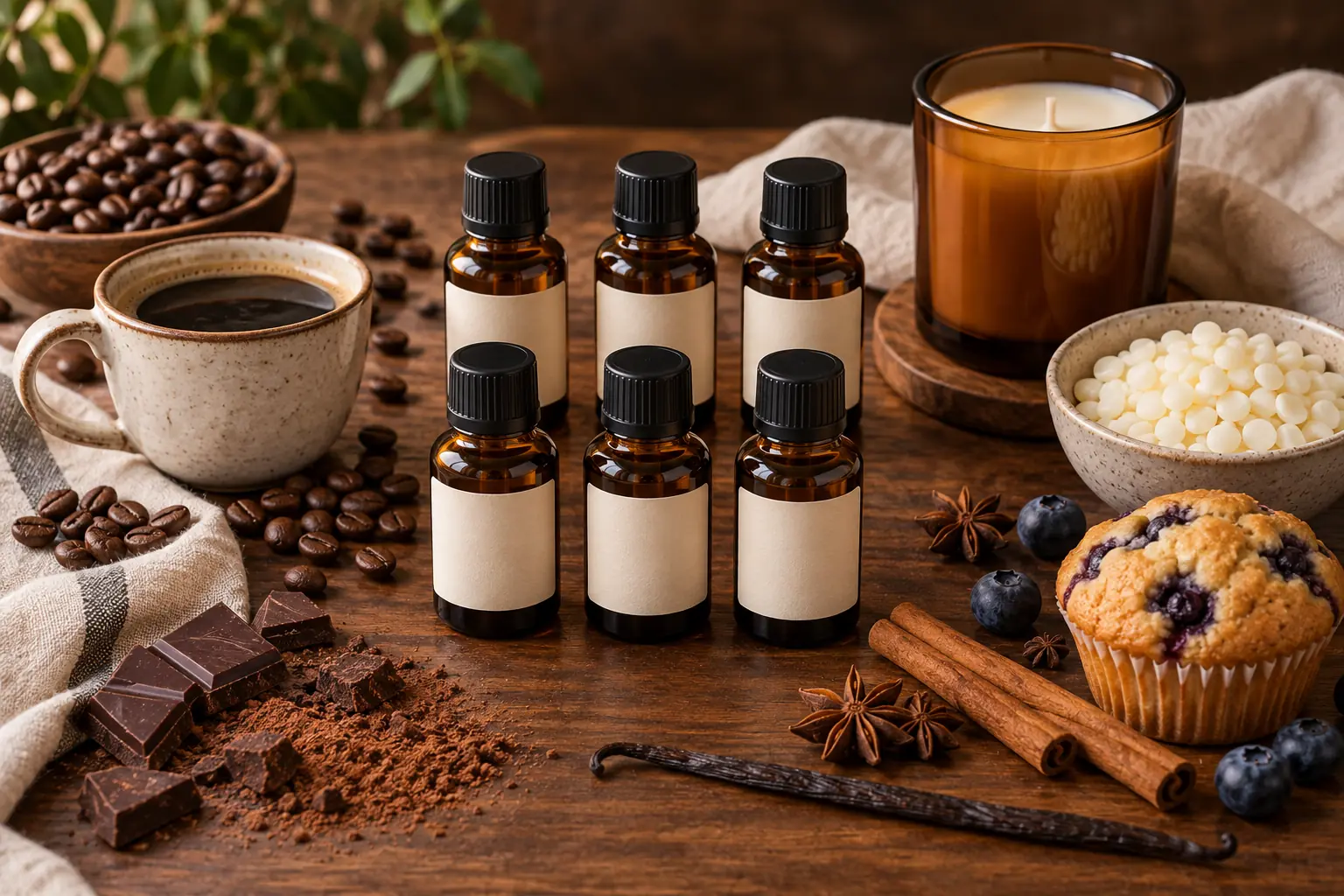
Fragrance oil product guide
Six café scents. One creative testing set.
The P&J Trading Coffee Shop Set moves from bold coffee and chai spice to chocolate, vanilla and blueberry bakery notes—but its six small bottles are best treated as a sampler, not production inventory.
Check availability on AmazonThe short answer
A cozy sampler with more range than a basic coffee candle.
Its value is the contrast between roasted coffee, creamy café drinks, warm spice and sweet bakery notes.
The P&J Trading Coffee Shop Set makes sense for hobby candle makers who want to compare several café-inspired fragrance directions in small batches. Coffee, Café Mocha, Chai Tea, Hot Chocolate, Blueberry Muffin and French Vanilla cover roasted, chocolate, spiced, creamy and fruit-bakery territory.
The limitation is volume. Each bottle holds 10 ml, so the set is better for scent evaluation, wax melts and small test candles than repeated full-size pours. Gourmand names can also hide major performance differences: Coffee may read darker and sharper, while French Vanilla or Hot Chocolate may behave softer in the same wax.
Inside the box
What does the P&J Trading Coffee Shop Set include?
The set contains six amber glass bottles, each listed at 10 ml (0.33 fl oz). The fragrances are Coffee, Café Mocha, Chai Tea, Hot Chocolate, Blueberry Muffin and French Vanilla. Together that is 60 ml of fragrance oil divided among six café-inspired profiles rather than one large bottle.
The bottles use euro-style dispensing inserts. Those inserts are convenient for small scent trials, but candle formulas should still be built on a scale. Drops are not a dependable production unit because drop size and oil density vary.
| Set format | Six coordinated fragrance oils in a presentation box |
|---|---|
| Bottle size | 10 ml per scent; 60 ml total across the collection |
| Included scents | Coffee, Café Mocha, Chai Tea, Hot Chocolate, Blueberry Muffin and French Vanilla |
| Candle use | Manufacturer lists the oils for diluted use in candle formulations |
| Other listed uses | Home and car diffusion plus diluted soap, bath, body and hair-care formulations |
| Documentation | Product-specific IFRA certification and Safety Data Sheet links are provided by the manufacturer |
| Purchase note | Amazon price, packaging and availability may change; verify the current listing before ordering |
“Coffee shop” does not mean six versions of coffee
Only Coffee and Café Mocha center directly on a coffee-house roast direction. Chai Tea adds spice, Hot Chocolate adds cocoa richness, Blueberry Muffin brings fruit and bakery sweetness, and French Vanilla works as a creamy standalone scent or blending note.
Scent-by-scent overview
What do the six fragrances bring to a candle?
Fragrance is subjective, and the same oil can smell different from the bottle, in melted wax and during a full burn. The descriptions below are practical scent directions—not a substitute for smelling and testing each oil yourself.
Coffee
The darkest and most direct roasted direction in the set. It can anchor a café candle by itself or give sweeter blends a less dessert-like backbone.
Try with: French vanilla or blueberry muffinCafé Mocha
A ready-made coffee-and-chocolate direction that may feel smoother and sweeter than straight Coffee. It is a logical starting point for makers who want a complete drink-inspired scent.
Try with: coffee or French vanillaChai Tea
A warm spiced beverage direction that broadens the set beyond coffee and chocolate. It can stand alone or add lift and spice to creamy blends.
Try with: French vanilla or café mochaHot Chocolate
A sweet cocoa-inspired profile for cozy candles and wax melts. It can become heavy when paired with other rich gourmands, so balance it with a cleaner coffee or vanilla note.
Try with: coffee or French vanillaBlueberry Muffin
The fruit-bakery outlier in the collection. It adds contrast to brown-scented coffee and chocolate profiles and can help a candle read more like a pastry case.
Try with: French vanilla or coffeeFrench Vanilla
A creamy sweet direction that can soften sharper coffee and spice notes. It is the set’s most flexible blender, but perceived strength still has to be evaluated in cured wax.
Try with: almost every scent in the setEvaluate scents in stages
Smell the oil on a fragrance blotter, then in cooled wax, then as cold throw after curing, and finally during a controlled burn. Do not reject or approve a candle based only on the fragrance straight from the bottle.
Candle-making fit
Is this fragrance oil set actually good for candles?
It can be useful for candles because the manufacturer specifically lists candle formulations among its intended diluted uses. That establishes suitability in principle, but it does not establish the correct percentage for every wax or guarantee the same scent throw in every formula.
Wax chemistry, fragrance percentage, mixing temperature, wick series, vessel diameter, cure time and room size all affect the finished candle. Soy wax may mute or reshape a scent that feels powerful in the bottle. Paraffin and some blends may produce stronger throw, while coconut-soy waxes can behave differently again. If you are choosing a base, start with our guide to selecting the right candle wax.
Where the small bottles help
- Comparing six scent directions before purchasing a larger size.
- Making small wax-melt samples or mini test candles.
- Learning how coffee, chocolate, spice, fruit and vanilla notes change after curing.
- Creating limited blend experiments without a large fragrance inventory.
- Building a coordinated gift set with different but related scent themes.
Where the small bottles become limiting
Ten milliliters is not much when fragrance is measured as a percentage of wax weight. A full-size candle may require more than one small bottle, depending on the vessel’s net fill, the oil’s density and the fragrance load allowed by the wax. Treat each bottle as a sample and avoid planning a multi-candle batch until you have weighed the available oil.
Want to compare the current set?
Use the Amazon listing to confirm today’s packaging, seller, availability and product details before purchasing.
See current Amazon details As an Amazon Associate, Candle Creating may earn from qualifying purchases.Fragrance math
Measure fragrance oil by weight—not drops
A candle formula should be repeatable. The dependable method is to weigh fragrance oil in grams on a scale accurate to at least 0.1 gram. Milliliters measure volume; fragrance load is normally calculated from weight.
Basic fragrance formula
Fragrance oil weight = wax weight × fragrance-load percentage. For example, 200 grams of wax at a 6% load calls for 12 grams of fragrance oil. This is only a math example—not a universal recommendation. Stay within the wax supplier’s allowed load and the applicable fragrance documentation.
How to weigh oil from a small bottle
- Place a small pour cup on the scale and tare it to zero.
- Dispense the fragrance slowly until the target weight is reached.
- Record the exact fragrance weight, wax weight and percentage.
- Do not assume that 10 ml equals 10 grams; density varies by formula.
- Use our candle wax calculator to establish the wax needed for your test container.
Start conservatively within the range allowed by your wax, then assess cold throw, hot throw and burn behavior. More fragrance is not automatically better. Excess oil can contribute to sweating, poor combustion, instability or a wick that no longer performs correctly. Two gourmand oils used at the same percentage can have very different perceived strength, so do not increase every scent just to match the boldest coffee or chocolate profile.
Creative starting points
Six blend ideas for coffee-shop candles
These ratios are starting points for the fragrance portion of a test formula. They do not replace the total fragrance-load limit for your wax. Make blotter tests first, then weigh a small wax test if the combination is promising.
| Vanilla Latte | 2 parts Coffee + 1 part French Vanilla. A roasted coffee center with a softer creamy finish. |
|---|---|
| Mocha House | 2 parts Café Mocha + 1 part Coffee. Chocolate-coffee sweetness supported by a darker roast note. |
| Vanilla Chai | 2 parts Chai Tea + 1 part French Vanilla. Warm spice rounded by a creamy base. |
| Blueberry Café | 2 parts Blueberry Muffin + 1 part Coffee. Fruit pastry in the foreground with a coffee-shop backdrop. |
| Hot Cocoa Bar | 2 parts Hot Chocolate + 1 part French Vanilla. A smooth dessert direction that should be tested for balance and wick behavior. |
| Spiced Mocha | 2 parts Café Mocha + 1 part Chai Tea. Chocolate and coffee supported by a warm-spice accent. |
For a different gourmand direction, compare this set with our P&J Trading Winter Set review. For woods, leather and less dessert-like profiles, see our P&J Trading Gentlemen’s Set review.
From bottle to burn test
A responsible way to test each fragrance
Testing one controlled formula at a time gives you more useful information than making six different full-size candles with several changing variables.
Choose one wax, vessel and wick
Keep the container diameter, wax batch and wick series identical across scent tests. That makes the fragrance the main variable.
Review the limits
Check the wax manufacturer’s fragrance-load range and review the fragrance maker’s current documentation. Use the lower applicable limit.
Weigh a small formula
Use a scale and document wax weight, fragrance weight, fragrance percentage, mixing temperature and pour temperature. Avoid drop-based recipes.
Mix according to the wax instructions
Add fragrance at the temperature and mixing time recommended for your wax. Flash point alone is not a candle-making instruction and should not be used as the fragrance-add temperature.
Cure before judging throw
Let the candle cure for the period recommended for the wax. Label each test so the scent and formula cannot be confused.
Burn in controlled cycles
Observe flame height, melt-pool development, soot, mushrooming, vessel temperature and hot throw. Stop the test if the candle behaves unsafely.
Change one variable at a time
If the candle is under-wicked, over-wicked or weak in throw, adjust a single factor and repeat. Our guide to common candle-making mistakes can help diagnose the result.
Buying decision
Pros, limitations and who should consider it
What works well
- Six coordinated scents offer more variety than one large bottle.
- Coffee, chocolate, spice, vanilla and fruit-bakery profiles cover several distinct gourmand directions.
- Small bottles reduce the commitment when you do not yet know which scent you prefer.
- Manufacturer provides links to product-specific IFRA and safety documentation.
- The set can support solo scents and multiple blend combinations.
- Presentation-box format makes it approachable as a craft gift.
What to consider
- Ten milliliters per scent can be too little for a full-size candle at some fragrance loads.
- Euro droppers encourage drop counting even though candle formulas should be weighed.
- Not every scent will perform equally in every wax.
- The café theme offers limited variety for makers seeking floral, citrus, aquatic, wood or fresh-linen scents.
- Fragrance oils are not the same thing as pure essential oils.
- A sampler still requires complete wick and burn testing.
This set is a reasonable fit if you…
- Want to compare several café and bakery fragrance styles before buying larger bottles.
- Make small test candles, wax melts or personal craft projects.
- Enjoy roasted coffee, chocolate, chai spice, vanilla and pastry-inspired profiles.
- Are comfortable documenting formulas and running complete burn tests.
Consider another option if you…
- Need enough oil for a repeatable production batch.
- Only want essential oils or an all-natural fragrance approach.
- Prefer bright florals, fresh citrus, aquatic scents, woods or unscented candles.
- Need a fragrance supplier that publishes a detailed candle performance profile for your exact wax.
Use it carefully
Fragrance oil safety and documentation
The manufacturer describes the oils as concentrated and intended for cosmetic and home-fragrance use, not ingestion. Its product page also directs users to keep the oils away from children and pets and to discontinue use if irritation occurs. Those instructions matter before the oil ever reaches hot wax.
Important candle-making precautions
- Read the current product label, Safety Data Sheet and IFRA documentation before use.
- Do not ingest fragrance oil or use it in lip products.
- Keep concentrated oil and hot wax away from children and pets.
- Wear appropriate eye and skin protection and work with ventilation.
- Clean spills promptly using the method in the product documentation.
- Never heat wax directly over an open flame.
- Do not assume “skin safe” means undiluted use or suitability for every application.
- Do not sell or gift a candle until the complete formula has passed repeatable burn tests.
Fragrance percentage can also change wick performance. If a previously stable unscented candle develops a small flame, heavy soot or an overheated vessel after fragrance is added, the full wax–fragrance–wick system must be retested. Review our guide to candle wick types before interpreting wick problems.
For the latest formulation language and downloadable documentation, consult the manufacturer’s Coffee Shop Set page.
Continue learning
Build the rest of your candle formula
Frequently asked questions
P&J Coffee Shop Set questions
What scents are in the P&J Trading Coffee Shop Set?
The set includes Coffee, Café Mocha, Chai Tea, Hot Chocolate, Blueberry Muffin and French Vanilla. Each fragrance is supplied in a 10 ml amber bottle.
Are these fragrance oils or essential oils?
They are fragrance oils. Fragrance oils are blended aromatic formulations and should not be described as pure essential oils. Follow the instructions and documentation for the actual product.
Can the Coffee Shop Set be used in soy candles?
The oils are marketed for diluted candle formulations, including use with candle wax. Performance in soy wax still depends on the wax, fragrance percentage, wick, vessel and cure. Make a small test and follow the wax supplier’s instructions.
How much fragrance oil should I put in a candle?
Use a percentage by weight that stays within both the wax manufacturer’s allowed fragrance load and the fragrance maker’s applicable documentation. Weigh the oil in grams; do not rely on a universal number of drops.
Will one 10 ml bottle scent an 8-ounce candle?
Possibly not at the load your formula requires. Milliliters cannot be converted accurately to fragrance weight without knowing the oil’s density, and an “8-ounce candle” may refer to vessel capacity rather than net wax weight. Weigh the oil and calculate from the actual wax weight.
Which coffee-shop scent is the best place to start?
Start with the direction you already enjoy. Coffee gives the darkest roasted profile, Café Mocha combines coffee and chocolate, Chai Tea adds spice, and French Vanilla offers a softer blending base. Blueberry Muffin is the most fruit-forward option.
Can I mix the six fragrances together?
Yes, but begin with two-scent blotter trials. Record the ratio, then test the most promising blend in a small wax batch. The total fragrance amount must remain within the limits for the wax and intended application.
Are coffee-shop scents only suitable for fall and winter?
No. Coffee, vanilla and blueberry bakery scents can work year-round. Chai, hot chocolate and richer mocha profiles often feel especially natural in autumn and winter collections, but naming, color and packaging strongly influence how customers interpret them.
Does a flash point tell me when to add fragrance to wax?
No. Flash point is a transport and handling characteristic, not a recommended mixing temperature. Follow the wax supplier’s temperature instructions and the fragrance manufacturer’s current guidance.
Is this set enough for a candle business?
It is better for initial scent screening than production. Once a fragrance passes your performance and burn tests, a larger bottle provides more consistent inventory for costing, batch records and repeat pours.
Leave a Reply