
Coconut–soy wax product guide
Do these wax beads make better container candles?
American Soy Organics Freedom Coconut Wax combines the easy measuring of wax beads with a coconut–soy formula developed for smooth tops, good glass adhesion, and strong fragrance performance.
Check availability on AmazonThe short answer
An approachable wax with room to grow.
The bead format is beginner-friendly, while the coconut–soy formulation gives experienced makers a useful alternative to straight soy.
Freedom Coconut Soy Wax Beads are a strong candidate for makers who want a plant-based container wax that is easy to measure, simple to melt, and designed for fragrance performance. The five-pound size is large enough for meaningful testing without committing to a commercial case.
The wax does not eliminate formulation work. Jar diameter, wick series, fragrance chemistry, dye, room temperature, and cooling speed still affect the finished candle. Treat the manufacturer’s temperatures as the starting process and use repeatable test batches to establish your own formula.
Product overview
What are Freedom Coconut Soy Wax Beads?
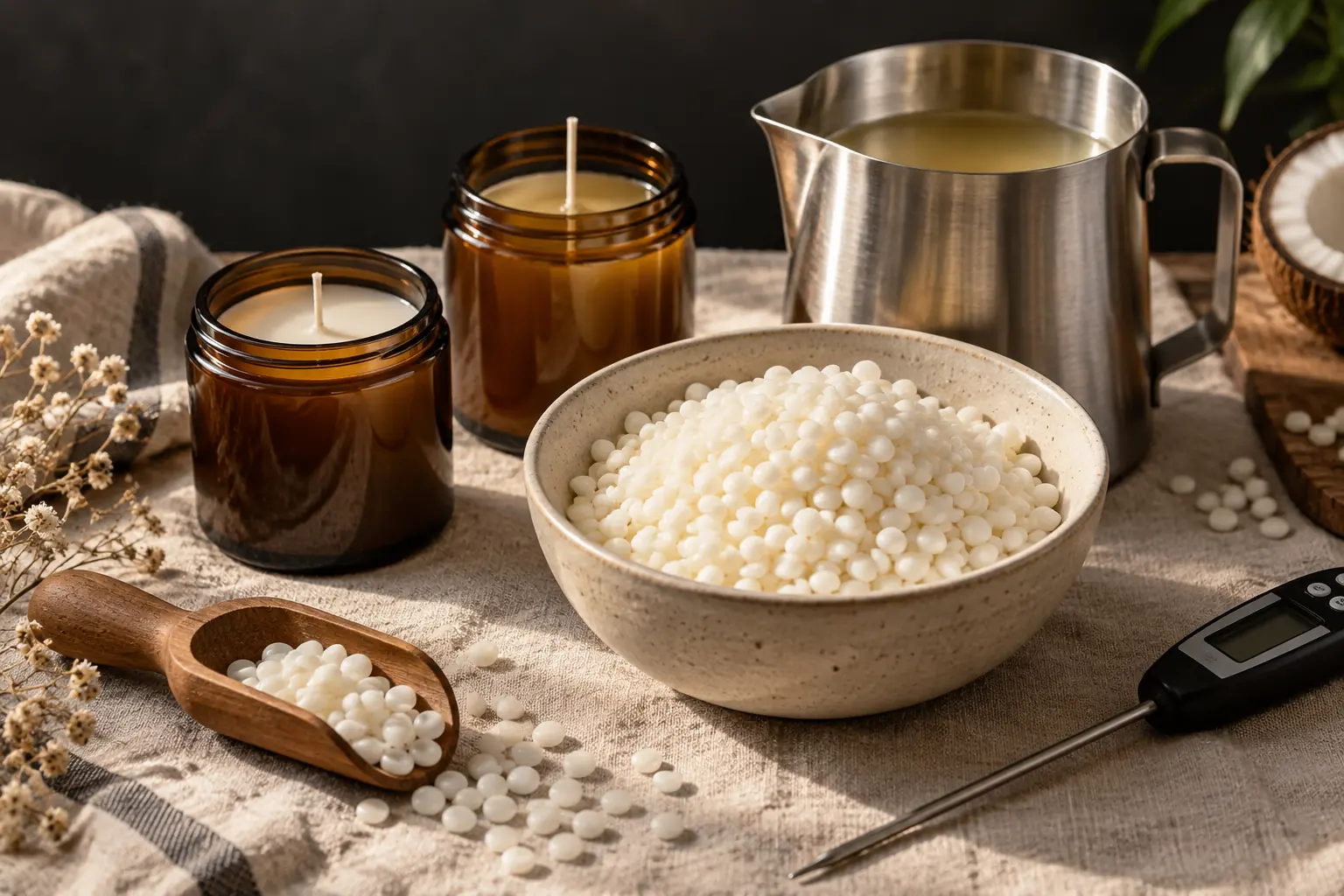
Freedom Coconut Wax is a pre-formulated blend from American Soy Organics. It begins with soy wax and adds coconut wax plus the manufacturer’s natural formulation components. The result is sold as small beads rather than flakes or a solid slab.
The bead shape does not change the candle once melted, but it makes the wax convenient to scoop, weigh, divide, and melt evenly. You can measure a four-ounce experiment without breaking apart a block or scattering thin flakes across the workbench.
American Soy Organics says the coconut component improves cold fragrance throw and sidewall adhesion compared with its Freedom Soy wax. It also says the production process is the same for the two Freedom formulas. Those are manufacturer claims rather than guarantees for every fragrance, wick, jar, or workshop.
| Brand | American Soy Organics |
|---|---|
| Product | Freedom Coconut Soy Wax Beads |
| Package size | Five pounds, equal to 80 ounces or approximately 2,268 grams of wax. |
| Wax type | A formulated blend of coconut wax and soy wax—not pure coconut wax and not straight soy. |
| Intended projects | Container candles, tealights, and wax melts according to the current listing. |
| Form | Small wax beads for weighing and portioning. |
| Formulation claims | Paraffin-free and beeswax-free. The manufacturer describes its Freedom waxes as all-natural. |
| Suggested heat point | The Amazon listing instructs makers to heat the beads to approximately 160°F. |
| Suggested pour point | The manufacturer recommends pouring around 135°F and allowing the candle to cool slowly. |
| Microwave use | The listing describes the beads as microwavable. Use only microwave-safe equipment, short intervals, careful stirring, and temperature monitoring. |
| Current price | Check Amazon. Price, seller, package details, and availability can change. |
Important distinction: “Coconut soy wax” describes a blend. If you specifically need 100% coconut wax, this is not that product. If you need a wax for freestanding pillars or tapers, choose a formula expressly designed for molded candles.
Not sure how blends compare with straight soy, beeswax, or paraffin? Start with our guide to choosing the right wax for different candles.
Inside the package
What do you receive—and what is missing?
This is a raw-material product rather than a candle-making kit. The package supplies wax beads; the maker supplies the rest of the candle system.
Five pounds of wax beads
The 80-ounce quantity supports several full-size test batches while remaining manageable for home storage and small-scale projects.
No premeasured formula
Fragrance, dye, container size, wick, and batch weight remain your decisions. That flexibility is useful, but it requires accurate records.
No candle hardware
Containers, wicks, wick stickers, centering bars, warning labels, lids, and packaging must be purchased separately.
No production equipment
You still need a digital scale, thermometer, melting vessel, heat source, stirring tool, and protected work surface.
Use the basic candle-making materials checklist before beginning, or visit the Candle Making Supplies hub for product guides.
Plan the batch
How many candles will five pounds of wax make?
Five pounds equals 80 ounces of wax before fragrance. Your yield depends on the candle’s actual fill weight—not the marketing capacity printed on the jar. An “8-ounce jar” may require substantially less than eight ounces of finished candle mixture once headspace is allowed.
For a more accurate plan, weigh the water required to reach your intended fill line, convert the water weight to an estimated wax weight, and confirm the final number with a real test pour. Our interactive candle wax calculator can calculate total wax from the container count and fill weight in ounces or grams.
Best practice: Keep at least several ounces in reserve during development. You may need a second pour, replacement test candle, or another sample after changing the wick. Using the entire bag in one untested batch leaves no matching wax for troubleshooting.
Weigh—do not count drops
How much fragrance oil should you use?
Fragrance load is normally calculated as a percentage of the wax weight. A six-percent fragrance load means six ounces of fragrance oil for every 100 ounces of wax—not six percent of the finished candle weight.
| Four-ounce wax test | At 6%, use 0.24 ounce (about 6.8 grams) of fragrance oil. |
|---|---|
| One pound of wax | At 6%, use 0.96 ounce (about 27.2 grams). At 8%, use 1.28 ounces (about 36.3 grams). |
| Five pounds of wax | At 6%, use 4.8 ounces (about 136 grams). At 8%, use 6.4 ounces (about 181 grams). |
The manufacturer’s online calculator uses six percent as its example, making that a sensible first test—not a universal prescription. Before increasing the load, check the current wax instructions, the fragrance supplier’s candle-safe usage rate, and the relevant safety documentation. Never assume that “more oil” automatically creates stronger hot throw.
Too much fragrance can cause sweating, poor combustion, wick instability, weak adhesion, or oil migration. Fragrance chemistry also changes wick demand: a formula that burns well with a light citrus oil may require a different wick with a dense vanilla or resinous blend.
A repeatable starting process
How to make a container candle with Freedom Coconut Wax
Follow the current directions supplied with the product and each fragrance. The workflow below turns the manufacturer’s published temperatures into a controlled small-batch process.
Write the formula first
Record the jar, inside diameter, wick series and size, wax weight, fragrance name, fragrance percentage, dye amount, heat temperature, mix temperature, pour temperature, room conditions, and date.
Prepare suitable containers
Use clean, undamaged vessels intended for candles. Attach and center the wick, then place the jars on a level, heat-resistant surface away from drafts.
Weigh the wax
Use a digital scale rather than measuring beads by volume. Weigh only the amount required for the test batch plus a small pouring allowance.
Melt to approximately 160°F
Use a controlled wax melter or double boiler and stir gently as needed. The listing also permits microwave melting; use short intervals, a microwave-safe vessel, careful stirring, and a thermometer. Never walk away from heating wax.
Add candle-safe fragrance
Weigh the oil separately and add it at the temperature directed by the wax and fragrance suppliers. Stir slowly and thoroughly without whipping air into the mixture.
Add candle dye if desired
Use dye made for wax. Water-based food coloring and botanical powders do not dissolve predictably in candle wax and may interfere with performance.
Pour around 135°F
American Soy Organics recommends pouring its Freedom Coconut Wax at about 135°F for smooth tops. Use that point as the initial test and record the actual temperature.
Cool slowly and undisturbed
Do not use a fan, refrigerator, cold garage, or open window to accelerate cooling. Rapid or uneven cooling can contribute to rough tops, pull-away, cracking, or sink areas.
Trim, label, and rest
Once fully solid, trim the wick to approximately 1/4 inch unless the wick supplier specifies otherwise. Label the formula and allow it to rest before judging appearance or fragrance.
Conduct a controlled burn test
Burn one test candle in timed sessions on a heat-resistant surface. Record flame height, melt-pool growth, soot, mushrooming, jar temperature, hot throw, wax consumption, and end-of-life behavior.
Hot wax can cause serious burns.
Use heat-resistant equipment, protect skin and eyes, keep water away from molten wax, and never heat wax directly over an open flame. Keep beads and finished candles away from children and pets. The beads may resemble food but are not edible.
The wax is only one variable
Choosing a wick for coconut soy wax
American Soy Organics recommends cotton wicks for its soy-based waxes. For Freedom Soy and Freedom Coconut, the company suggests Stabilo/CD or Premier series as general starting families. Its FAQ proposes beginning around a Stabilo 10 or Premier 765 in a three- to four-inch jar, then adjusting through testing.
That advice is a starting point—not a finished recipe. A four-inch jar covers far more surface area than a three-inch jar, and fragrance, dye, wick treatment, vessel shape, and desired burn time all influence the result. Some containers may require two or more smaller wicks rather than one oversized wick.
- Test at least three adjacent wick sizes with the same wax, fragrance, load, dye, jar, and pour process.
- Let every candle rest for the same amount of time before comparing it.
- Trim every wick to the same starting length.
- Run repeatable burn sessions and allow full cooling between them.
- Continue through the lower half of the candle; early performance does not predict end-of-life heat.
- Reject formulas that create excessive flame, soot, repeated self-extinguishing, unstable mushrooms, dangerously hot vessels, or poor container integrity.
Read our guide to different candle wick types before buying a large quantity of one size.
Diagnose one variable at a time
Common Freedom Coconut Wax problems
Rough or uneven tops
Confirm the approximately 135°F pour, stable room temperature, prewarmed—not hot—containers if the room is cold, and slow cooling without fans. Avoid excessive stirring immediately before pouring.
Wet spots or glass pull-away
These are often visual adhesion changes caused by temperature differences and wax contraction. Clean vessels, consistent jar temperature, slow cooling, and stable storage may reduce them, but they do not automatically mean the candle is unsafe.
Weak hot throw
Review wick size, fragrance compatibility, fragrance percentage, mixing, rest time, and room size. More fragrance is not always the solution; an incorrectly sized wick may fail to disperse scent effectively.
Frosting or pale crystals
Soy-based wax can develop crystalline frosting. Minimize large temperature swings, over-heating, and heavy dye. Frosting is primarily aesthetic and can occur even in a functional candle.
Tunneling
A wick that is too small may not create adequate melt-pool growth. Compare adjacent wick sizes and evaluate the full candle rather than forcing an edge-to-edge pool immediately.
Tall flame or hot jar
Extinguish the candle. Confirm a 1/4-inch wick trim, reduce wick size, and retest. Never sell or gift a formula that has not passed complete burn testing.
For a broader diagnostic checklist, see how to avoid common candle-making mistakes.
Balanced assessment
Advantages and limitations
What the wax does well
- Beads are easy to weigh, portion, store, and melt.
- Five pounds is useful for development without requiring a commercial case.
- Designed for container candles, tealights, and wax melts.
- The manufacturer reports improved cold throw and sidewall adhesion.
- Paraffin-free and beeswax-free for makers seeking that formulation.
- Uses the same basic process as Freedom Soy wax.
- The manufacturer says the fully formulated wax needs no additives.
Where it is limited
- It is a coconut–soy blend, not pure coconut wax.
- It is not presented as a freestanding pillar or taper wax.
- Wicks, fragrance, dye, vessels, and equipment are separate purchases.
- No wax can guarantee strong throw with every fragrance.
- Natural-wax appearance can still change with cooling and storage.
- Every vessel and fragrance combination requires burn testing.
- Amazon pricing and availability may fluctuate.
Who it fits
Should you buy Freedom Coconut Soy Wax Beads?
Consider this wax if you:
- Want to make container candles, tealights, or wax melts.
- Prefer beads over flakes or slabs for easy weighing and storage.
- Want a paraffin-free and beeswax-free coconut–soy formulation.
- Need enough wax for several structured test batches.
- Already use Freedom Soy and want a similar process with coconut wax added.
- Are willing to test wicks and fragrance combinations instead of relying on one recipe.
Choose another wax if you:
- Need a hard wax formulated for freestanding pillars or molded tapers.
- Want pure coconut wax or pure soy wax rather than a blend.
- Need a complete kit with fragrance, vessels, wicks, and tools.
- Want to pour a large production run before performing small burn tests.
- Require a formula with no natural variation in appearance.
Our view: The five-pound Freedom Coconut package sits in a useful middle ground. It is approachable enough for a first serious container-candle project yet substantial enough to develop and repeat a formula. Its value depends less on the words “coconut soy” and more on whether you follow a measured process and complete the burn testing.
Ready to check the current listing?
Confirm the five-pound size, product variation, seller, directions, delivery date, and return terms directly on Amazon before ordering.
Check the wax on Amazon Paid link. Price and availability may change.Before you order
Coconut soy wax buying checklist
- Confirm that the affiliate link opens the five-pound Freedom Coconut Soy Wax Beads variation.
- Check that the listing still identifies the product as coconut and soy wax.
- Review the current manufacturer melting, fragrance, pouring, and cooling directions.
- Confirm that container candles, tealights, or melts match your intended project.
- Choose candle-safe vessels with known inside diameters.
- Purchase several adjacent wick sizes rather than guessing one size.
- Verify the fragrance supplier’s candle-safe usage rate and documentation.
- Have a scale and thermometer ready before opening the package.
- Reserve wax for repeat tests instead of pouring the full bag at once.
Continue learning
Build a repeatable candle formula.
Frequently asked questions
Coconut soy wax beads FAQ
Is Freedom Coconut Wax pure coconut wax?
No. It is a formulated blend of coconut wax and soy wax. The product is useful for makers who want characteristics of both waxes, but it should not be described as 100% coconut wax.
Do the beads smell like coconut?
Do not expect the wax itself to make a coconut-scented candle. “Coconut” identifies part of the wax blend, not an added coconut fragrance. Add a compatible candle fragrance if you want a recognizable coconut aroma.
What temperature should I use?
The current Amazon directions say to heat the beads to approximately 160°F. American Soy Organics recommends pouring Freedom Coconut Wax around 135°F and cooling it slowly. Recheck the current package instructions and record the temperatures used in every test.
Can Freedom Coconut Wax be melted in a microwave?
The listing describes it as microwavable. Use a microwave-safe container, short heating intervals, careful stirring, heat protection, and a thermometer. Never use metal, leave the wax unattended, or assume the container is cool enough to touch.
How much fragrance oil should I add?
A six-percent load is a practical first test and is the example used by the manufacturer’s fragrance calculator. For one pound of wax, six percent equals 0.96 ounce of fragrance oil. Do not exceed the current wax or fragrance supplier limits, and remember that higher fragrance loads do not guarantee stronger candles.
Can I use the wax for pillars?
This product is promoted for container candles, tealights, and wax melts. Use a wax specifically formulated for freestanding pillars or molded tapers when the candle must support itself outside a container.
Does this wax need additives?
American Soy Organics describes Freedom Coconut Wax as fully formulated and says it should not require additives. Adding beeswax, stearic acid, or another wax changes the formula and requires a new round of wick and burn testing.
How long should coconut soy candles cure?
There is no single cure period that proves every fragrance formula. Let the candle cool fully before handling, then evaluate matched test candles after consistent rest periods—for example, 48 hours, seven days, and fourteen days. Use the comparison to establish when your chosen fragrance reaches acceptable performance.
Why are price and ratings not displayed here?
Amazon prices, sellers, ratings, availability, and package details can change. Use the affiliate button to view the current purchasing information.
Leave a Reply