
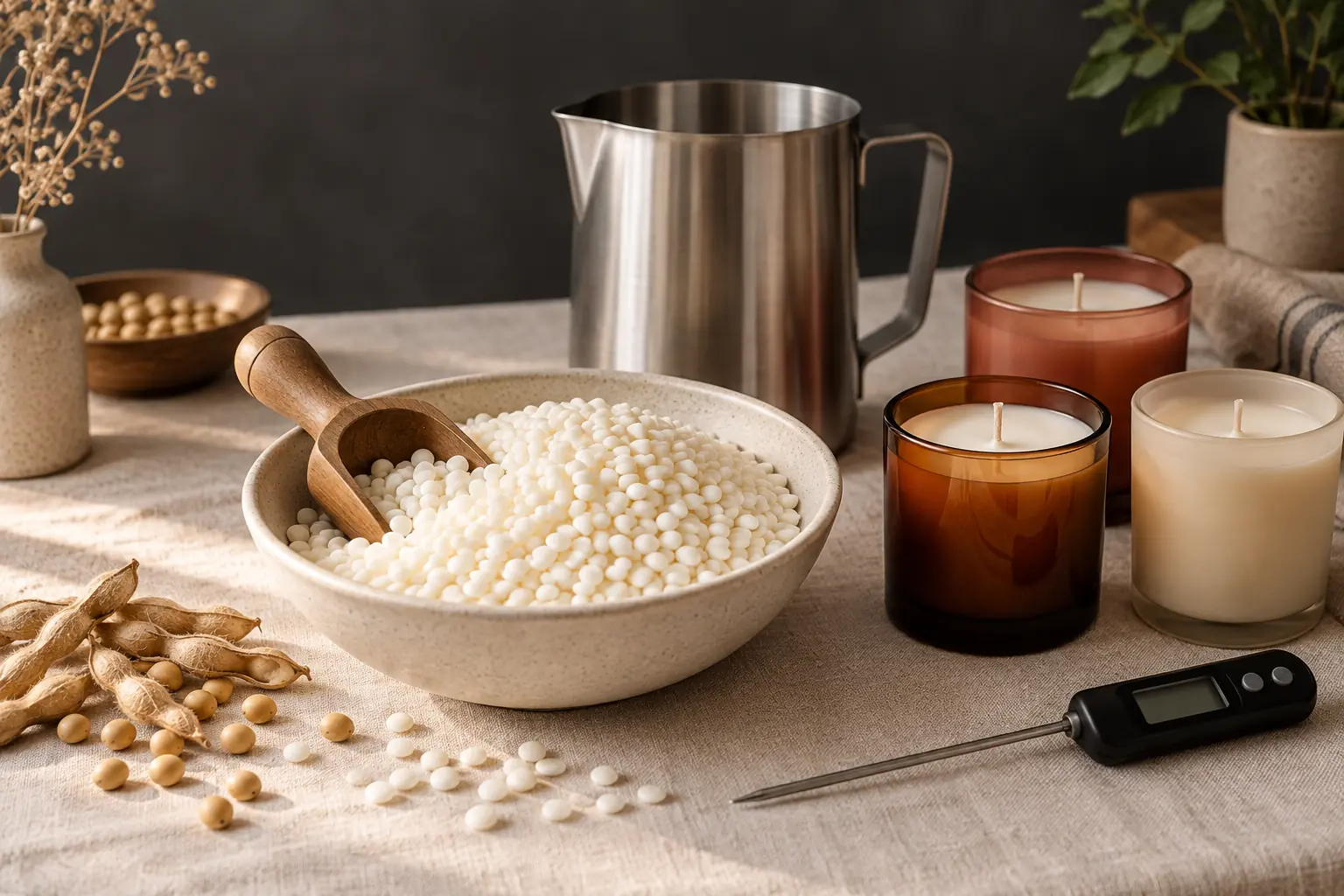
Container soy wax product guide
Is Millennium the soy wax for serious testing?
Ten pounds of easy-to-measure beads provide enough wax to develop a repeatable container-candle formula—while Millennium’s higher melt point, low pour temperature, and color retention set it apart from softer soy blends.
Check availability on AmazonThe short answer
Stable, versatile, and built for repeat batches.
Millennium rewards careful temperature control and testing with a useful combination of color retention, hot throw, and container-candle stability.
American Soy Organics Millennium Wax Beads are a strong choice for makers ready to move beyond a tiny starter bag and develop a repeatable soy candle. The ten-pound quantity supports multiple fragrance and wick tests without committing to a commercial case.
This is not a shortcut around formulation work. The manufacturer categorizes Millennium as an intermediate wax, recommends a notably low pour temperature, and expects the maker to adjust wick size for fragrance, dye, and vessel diameter. The payoff is a fully formulated wax with a melt point in the 130°F range and especially good color retention.
Product overview
What are Millennium Soy Wax Beads?
Millennium is American Soy Organics’ most stable container soy wax formulation. It is sold as small beads rather than flakes or a solid slab, making it easy to scoop, weigh, divide, and melt in controlled batches.
The manufacturer describes Millennium as an all-natural, fully formulated soy wax with a melt point in the 130°F range. “Fully formulated” means the wax is intended to work without the stabilizing additives commonly added to a basic soy wax. It does not mean every fragrance, color, jar, or wick will perform automatically.
Compared with the company’s lower-melt Freedom waxes, Millennium is positioned for greater stability and superior color retention. American Soy Organics’ comparison chart rates its hot throw as very good, its cold throw as good, and its degree of difficulty as intermediate.
| Brand | American Soy Organics |
|---|---|
| Product | Millennium Wax Beads |
| Package size | Ten pounds, equal to 160 ounces or approximately 4,536 grams of wax. |
| Wax type | Fully formulated container soy wax. The manufacturer describes Millennium as all-natural. |
| Formulation claims | Paraffin-free and beeswax-free according to the current product title. |
| Melt point | In the 130°F range according to American Soy Organics. |
| Recommended projects | Container candles, container votives, tealights, wax melts or tarts, floating candles, and colored candles according to the manufacturer comparison chart. |
| Pour guidance | Pour below 115°F for smoother tops. This is substantially cooler than many wax processes and requires temperature monitoring. |
| Fragrance capacity | The manufacturer chart lists a maximum of 12%. Treat that as an upper technical limit—not the ideal starting load. |
| Microwave use | The manufacturer chart marks Millennium as microwave-compatible. Use only suitable equipment and controlled intervals. |
| Current price | Check Amazon. Price, seller, package details, and availability can change. |
Do not confuse melting point with processing temperature. A melt point in the 130°F range describes when the wax changes state. Your fragrance supplier and current package directions may require a different working temperature for complete mixing. Heat only as needed and record the actual process.
Compare Millennium with soy blends, beeswax, and paraffin in our guide to choosing the right wax for different candles. If you prefer a softer coconut–soy blend, see our Freedom Coconut Soy Wax Beads review.
Inside the package
What do you receive—and what must you supply?
This Amazon product is wax rather than a complete candle-making kit. The ten-pound bag supplies a substantial amount of raw material, but every other part of the candle system remains your responsibility.
Ten pounds of wax beads
The 160-ounce supply supports a useful development cycle: small trials, wick comparisons, fragrance comparisons, confirmation batches, and finished candles.
No fixed recipe
Fragrance percentage, dye, vessel, wick series, wick size, batch temperature, and rest time must be selected and documented by the maker.
No candle hardware
Containers, wicks, tabs, wick stickers, centering bars, warning labels, lids, and packaging are separate purchases.
No production tools
You still need a digital scale, thermometer, controlled melting setup, pouring pitcher, stirring tool, protective equipment, and level cooling area.
Review the basic materials needed to make homemade candles, then visit the Candle Making Supplies hub for more product guides.
Plan the full bag
How many candles will ten pounds of soy wax make?
Ten pounds equals 160 ounces of wax before fragrance. Yield must be based on the actual wax fill weight, not the nominal jar size. A vessel marketed as an “8-ounce jar” may hold less than eight ounces of finished candle mixture after allowing headspace.
Fragrance adds to the finished batch weight. For example, 160 ounces of wax with a 6% fragrance load produces 169.6 ounces of candle mixture before normal transfer loss. That does not automatically create twenty-one “8-ounce” candles because the correct fill weight must be established for the actual vessel.
Use our interactive candle wax calculator to calculate wax by container count and fill weight in ounces or grams.
Development strategy: Do not pour all ten pounds into one untested formula. Divide the bag into small controlled batches, reserve matching wax for repeat tests, and scale only after the candle performs safely through its complete burn life.
Start below the maximum
How much fragrance oil should you use?
American Soy Organics lists a maximum fragrance load of 12% for Millennium, but maximum capacity is not the same as the best formula. A high load can make wicking more difficult, increase cost, cause sweating, or weaken performance. Six percent is a more controlled first test and is the example used by the manufacturer’s fragrance calculator.
| Four-ounce wax test | At 6%, use 0.24 ounce (about 6.8 grams) of fragrance oil. |
|---|---|
| One pound of wax | At 6%, use 0.96 ounce (27.2 grams). At 8%, use 1.28 ounces (36.3 grams). At 10%, use 1.6 ounces (45.4 grams). |
| Ten pounds of wax | At 6%, use 9.6 ounces (272 grams). At 8%, use 12.8 ounces (363 grams). At 10%, use 16 ounces (454 grams). |
Fragrance load is calculated from the wax weight: fragrance weight ÷ wax weight × 100. Check the fragrance supplier’s candle-safe usage rate and safety documents before selecting a percentage. The lower of the wax limit and fragrance limit controls.
Dense vanilla, spice, amber, resin, and gourmand oils can behave differently from light citrus or herbal fragrances. Every new oil may change wick demand, burn rate, color, cure behavior, and surface appearance. Test it as a new candle formula—even when the fragrance percentage remains unchanged.
A controlled Millennium process
How to make container candles with Millennium wax
Follow the directions printed on the current package and the fragrance supplier’s instructions. The method below emphasizes the decisions that matter most with a low-pour-temperature soy wax.
Write the test formula
Record vessel dimensions, wick series and size, wax weight, fragrance name and percentage, dye amount, melting and mixing temperatures, target pour temperature, room conditions, and date.
Prepare candle-safe vessels
Inspect clean containers for chips, cracks, or manufacturing defects. Attach and center the wicks, then place the jars on a level, heat-resistant surface away from drafts.
Weigh the beads
Measure by weight with a digital scale rather than scoops or cups. Include a small transfer allowance, especially for tiny batches where residue represents a larger percentage.
Melt with controlled heat
Use a wax melter or double boiler and monitor temperature continuously. If using the microwave-compatible option, work in short intervals with suitable equipment and stir carefully. Never heat unattended or over an open flame.
Add fragrance at the correct working temperature
Use the current wax and fragrance supplier directions. Stir slowly and thoroughly for consistent distribution without whipping unnecessary air into the mixture.
Add candle dye if desired
Millennium is designed to retain color well, but dye still affects wick demand. Use wax-compatible dye, measure it consistently, and treat every color change as a formula change.
Allow the wax to cool
Millennium’s melt point is not its pour point. Watch the thermometer as the wax cools, stir as needed for uniformity, and prepare to pour below 115°F as recommended by American Soy Organics.
Pour below 115°F
Pour slowly into the prepared vessels without splashing the wick or jar wall. Record the actual temperature rather than writing the target from memory.
Cool in stable conditions
Leave the candles level and undisturbed. Avoid fans, refrigerators, open windows, cold floors, and large temperature swings that can increase frosting, cracking, or uneven adhesion.
Rest, trim, and burn test
After the wax is fully set, trim the wick to roughly 1/4 inch unless its supplier specifies otherwise. Label the formula, use a consistent rest period, and test the complete candle before repeating the batch.
Molten wax and fragrance require care.
Use heat-resistant equipment, protect skin and eyes, keep water away from molten wax, and never leave the heating process unattended. Wax beads may resemble food but are not edible. Keep raw materials and finished candles away from children and pets.
Start with a family—not a final answer
Choosing a wick for Millennium soy wax
American Soy Organics recommends Stabilo—often called CD—and Premier wick families for Millennium. For a three- to four-inch jar, the company suggests starting around a Stabilo 14 or Premier 777 and working up or down.
That range covers containers with dramatically different surface areas, so it cannot replace a wick test. The manufacturer also notes that Millennium burns more aggressively than many natural waxes with a similar melt point. Do not automatically oversize the wick merely because the wax is relatively firm.
- Test at least three adjacent wick sizes in otherwise identical candles.
- Keep wax lot, fragrance, fragrance load, dye, vessel, pour temperature, and rest period constant.
- Use a heavier wick only when test evidence supports the change.
- Remember that darker dye may require additional wick testing.
- Evaluate flame height, soot, mushrooming, melt-pool growth, jar temperature, and wax consumption.
- Continue testing through the lower half of the jar, where retained heat can increase.
- Repeat the final candidate to confirm that the result is reproducible.
Our guide to different candle wick types explains why wax, diameter, fragrance, and wick construction must be evaluated together.
Change one variable at a time
Common Millennium soy wax problems
Rough or uneven tops
Confirm that the wax was poured below 115°F, the vessels were level, and the candles cooled without drafts. Compare small pour-temperature changes while keeping every other variable constant.
Wax thickens before pouring
A low pour temperature narrows the working window. Prepare vessels first, use an accurate thermometer, make smaller batches, and organize the workspace so the cooled wax can be poured promptly.
Frosting or pale crystals
Frosting is common in soy wax. Stable cooling and storage temperatures, limited overheating, and restrained dye use may reduce it, but a functional natural-wax candle can still frost.
Weak scent performance
Review wick size, fragrance compatibility, mixing, fragrance percentage, rest time, and room size. Do not jump directly to the 12% maximum; excessive oil can create new problems.
Tunneling or weak flame
The wick may be too small, clogged by heavy dye or fragrance, or poorly centered. Compare adjacent sizes in matched test candles rather than changing several ingredients at once.
Tall flame or hot vessel
Extinguish the candle. Verify a 1/4-inch trim, reduce wick size, and retest. A candle that overheats late in its life is not rescued by good performance during the first burn.
Use our complete guide to avoiding common candle-making mistakes when documenting the next test.
Balanced assessment
Advantages and limitations
What Millennium does well
- Beads are easy to weigh, portion, store, and melt.
- Ten pounds supports real formula development and confirmation batches.
- The fully formulated wax does not require routine stabilizing additives.
- The manufacturer rates hot throw as very good.
- Millennium is designed to retain color better than its other waxes.
- It works across several contained candle and melt formats.
- Paraffin-free and beeswax-free for makers seeking that formulation.
Where it is limited
- The low pour temperature requires patience and an accurate thermometer.
- The manufacturer categorizes the wax as intermediate rather than beginner.
- It is not the company’s wax for freestanding pillars or tapers.
- Natural soy can still frost or show visual variation.
- Wicks, fragrance, vessels, dye, and equipment are separate purchases.
- The 12% fragrance capacity should not be treated as a default recipe.
- Every fragrance and vessel combination requires complete burn testing.
Who it fits
Should you buy Millennium Soy Wax Beads?
Consider Millennium if you:
- Want a stable, fully formulated soy wax for contained candle formats.
- Need enough wax to compare several wicks and fragrances properly.
- Prefer bead-form wax over flakes or slabs.
- Plan to make colored candles and value strong color retention.
- Want a paraffin-free and beeswax-free wax.
- Are comfortable monitoring a pour temperature below 115°F.
- Will document and repeat complete burn tests before scaling.
Choose another wax if you:
- Need freestanding pillars or molded tapers.
- Want the simplest possible first candle with a wider pour window.
- Need a complete kit with vessels, wicks, fragrance, and tools included.
- Want a coconut–soy blend rather than an all-natural soy formulation.
- Plan to pour the whole bag before validating the formula.
Our view: Millennium makes the most sense for the careful hobbyist or small-batch maker who wants enough material to build a process—not merely follow a single recipe. The ten-pound size offers useful value only when part of it is deliberately reserved for wick comparisons, repeat tests, and formula confirmation.
Ready to check the current listing?
Confirm the ten-pound variation, ASIN, seller, package directions, delivery date, and return terms directly on Amazon before ordering.
Check Millennium wax on Amazon Paid link. Price and availability may change.Before you order
Millennium soy wax buying checklist
- Confirm that the affiliate link opens the ten-pound B00W0TPCSY variation.
- Verify that the listing still identifies the wax as Millennium beads.
- Review the current melting, mixing, fragrance, and pouring directions.
- Make sure a contained candle or wax-melt format matches your project.
- Select candle-safe vessels and record their inside diameters.
- Buy several adjacent wick sizes rather than one guessed size.
- Check each fragrance supplier’s candle-safe usage rate.
- Prepare an accurate scale and thermometer before opening the bag.
- Reserve enough wax for repeat and confirmation tests.
Continue learning
Turn ten pounds into a tested formula.
Frequently asked questions
Millennium soy wax beads FAQ
Is Millennium a pure soy wax?
American Soy Organics describes Millennium as an all-natural, fully formulated soy wax. “Fully formulated” means it includes the manufacturer’s stabilizing formulation rather than functioning as an untreated soy-wax base. It is listed as paraffin-free and beeswax-free.
What temperature should Millennium wax be poured?
The manufacturer recommends pouring Millennium below 115°F for smoother tops. Use an accurate thermometer and treat that guidance as the starting point for controlled tests rather than guessing by appearance.
What is the melting point?
American Soy Organics places the melt point in the 130°F range. That is not automatically the temperature for adding fragrance or pouring; follow the current wax and fragrance directions for those steps.
How much fragrance can Millennium hold?
The manufacturer comparison chart lists a 12% maximum. Begin with a smaller controlled load—often around 6%—and increase only when the fragrance supplier permits it and testing shows a real benefit. Maximum oil capacity is not necessarily the safest or strongest-performing formula.
Which wick should I use?
The manufacturer recommends Stabilo/CD and Premier wick families and suggests Stabilo 14 or Premier 777 as starting points in a three- to four-inch jar. Vessel diameter, fragrance, dye, and wick construction still require testing above and below the starting size.
Can Millennium wax be microwaved?
The manufacturer chart marks it as microwave-compatible. Use a microwave-safe vessel, short intervals, heat protection, careful stirring, and a thermometer. Never use metal or leave heating wax unattended.
Can Millennium be used for pillars?
The manufacturer does not recommend Millennium for freestanding pillars or tapers. It is suitable for container candles and container votives, along with tealights, melts, and certain floating-candle projects. Use a dedicated pillar wax when the candle must support itself.
How long should soy candles cure?
No single rest period proves every fragrance formula. Let candles cool completely, then compare matched samples after consistent intervals such as 48 hours, seven days, and fourteen days. Establish the rest period that produces repeatable results for the chosen fragrance.
Why are the Amazon price and rating not shown here?
Prices, sellers, ratings, availability, and package details can change. Use the affiliate button to view current purchasing information directly on Amazon.
Leave a Reply